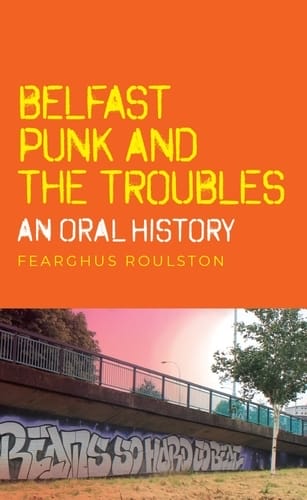
by Fearghus Roulston
Manchester University Press, 2022, 208pp, £85, hardback
Belfast punk is arguably the most written about of all the punk scenes within Northern Ireland, and most commonly from within the context of ‘The Troubles’, the 30-year civil war that raged in Northern Ireland from 1969 until 1998 when we entered into a slow peace process. In part this coverage is because Belfast is the area in which punk became most well known in terms of bands whose notoriety or fame crossed onto the mainland in a sustained way. In part it is potentially also because Belfast is more synonymous with ‘The Troubles’ than somewhere like Coleraine or Newry. A consequence of this is that punk in Northern Ireland is predominantly seen as linked to ‘The Troubles’ which ties it to a specific moment in time that for many is the most painful, the most difficult and not necessarily what they want to focus on, or reflective of punk experiences and identities now.
A possibly unintended consequence is that the focus has very commonly been on men and how they experienced or lived punk during ‘The Troubles’. This is not a unique feature of punk, or subcultural, writing that is focused on an area that has undergone or is still experiencing war or civil war. The choice (and it is a choice) to focus on men stems from the subconscious academic misogyny that assumes only men have something interesting to add, experiences worth hearing or where even involved. This is driven by the presumption that women would be more inclined, or forced, to remain at home rather than attend gigs due to the conflict. Roulston’s book, and other earlier publications on the subject, have repeatedly demonstrated that these assumptions are not only wrong but limit the possibility of what we can understand about subcultural identity, experiences and lives in such situations.
As a result of the above, it was a delight to note that Fearghus Roulston’s book Belfast Punk and The Troubles (2022) focused on oral histories which commonly provide a longer narrative and greater insight far beyond a moment in time, and that he had included a chapter focused on gender (chapter 5) which is structured around Claire’s interview. It is very gratifying that the interviews undertaken with punk women are not consigned solely to the chapter on gender. Chapter 3 is structured around an in-depth use of Alison’s interview, although it is worth noting that this, at page 64, is the first time in the book a woman’s interview has been drawn upon or referred to.
Roulston’s book is split into six chapters, alongside an introduction and conclusion. Each chapter picks up a theme pertinent to oral history concerns, and provides detailed, context-specific historical background before using an interview in granular detail to explore that theme in relation to punk and lived experience. Chapter one is focused on sectarianism, segregation and punk, chapter two explores the Belfast punk scene in cultural memory whilst chapter three examines epiphany, transgression and movement. Chapter four explores making affective and political spaces with chapter five focused on gender, respectability and emigration, and finally, chapter six considers collecting, storytelling and memory. At times the placement of the themes can seem a little arbitrary or out of place, for example, emigration would fit more comfortably and naturally with chapter three’s themes of epiphany, transgression and movement (especially if transgression, which deals significantly with gender, were moved to chapter five as its more natural home). However, taken as a whole the approach works and creates a book that can be picked up thematically for use with students as a teaching resource. This would be best suited to honours level undergraduate and especially master’s students with an interest in heritage, storytelling, oral histories and community.
The method of oral history is an important one to use in areas of sustained conflict and fracture, and Roulston’s handling of it is deft, respectful and clearly signposted for readers throughout. He allows it room to breathe as a method but also as a shaper of content, noting that its use makes the broader concerns focus on two things:
First, I am interested in what they [punks]were… What does the specifically Northern Irish manifestation of punk tell us about the material, social and cultural world of the North in this period? … Secondly, I am interested in how the congregations of the punk scene are remembered by former participants telling their stories in the present (p 1).
Roulston’s handling of sectarianism is worthy of mention. Commonly in punk scholarship on Northern Ireland, sectarianism is often either the elephant in the room or punk is narrativised as a means by which it was overcome. The sectarianism itself is commonly not well explained or detailed, in small part because to do so means acknowledging that it existed (and sometimes thrived) within punk spaces, in large part though it is often because it is so complicated to explain coherently to those who are outside of those communities. How does one really explain the way in which children imbibe the symbolic meanings (for they are plural) and identity ramifications of which foot you kick a ball with or how you pronounce the letter ‘h’? Dealing with sectarianism in writing about Northern Ireland also means dealing with the pain and violence it brings which can be very difficult to convey in a way that remains respectful to your interviewees’ experiences whilst not over-explaining them or making them into monolithic representations. This is an area that Roulston strikes an exemplary balance in. He does not shy away from critiquing other punk scholars on Northern Ireland for being too keen to either buy into or create a narrative of punk that is solely resistant to sectarianism whilst acknowledging the importance of punk in creating a shared space that both Catholics and Protestants needed and created “in response to the segregated conditions of life in Belfast in the 1970s” (p 23). In response to Graeme’s interview he notes:
[P]unk in Belfast is not exactly about transgression or resistance. Instead, it is a set of practices that allow its practitioners to negotiate the boundaries of Northern Irish social life in a safe way, but largely through acts of camouflage, concealment and avoidance rather than through acts aimed at countering sectarian narratives or producing alternative narratives (p 150).
Looking back to connect to the now is where Roulston really shines and seems most at ease with his material. It is also where the interviewees are front and centre, their narratives being used to weave a much richer tapestry than some other punk scholarship on reflective memories. This is also where the lack of engagement with current punk scholarship on Northern Ireland is glaringly obvious by its omission. There have been a number of works since 2019 that deal with some of the issues and the positives of this approach in relation to punks in Northern Ireland specifically and none of them are referenced or used. Engaging with them, especially given the handling of gender in Roulston’s book and those articles,1 would have added significant depth to the material that could have added much needed layers to that vital ongoing conversation.
Likewise, Roulston acknowledges the complicated nature of sectarianism and makes clear to the reader with a casual (or limited) knowledge of Belfast the way in which it is created and continues to create “a spatial framework within the city whereby working-class areas became almost exclusively Catholic or Protestant following the pattern laid out in the nineteenth century but to a more extreme degree” (p 24). This section of the book could be a valuable resource for sociology, history, religious studies and heritage students as well as for early-stage postgraduate students considering their research design process and how to deal with complex concepts within their potential data.
A lot has been written about punk, less so about punk in Northern Ireland, but it is not a new subject by any means. Roulston’s contribution sits in an odd position in that it adds something and nothing at the same time. If one goes through the book focusing solely on the punk there is nothing new, nothing that has not been said elsewhere about punk in Northern Ireland: it came from a charged violent time in which social worlds, lives and identities were shaped by sectarianism and division, there was the wide range of punk genre’s being catered for as elsewhere, there was division between fans of the political approach of bands like Stiff Little Fingers compared to the more overt political protesting or commenting of black armband in memory of Bobby Sands worn by members of The Undertones on the Top of the Pops performance, punks had frequent but varied encounters with the armed forces, the police and other authority figures that were more than the ‘cheap’ lyrics that talked about such encounters from bands on the mainland UK. However, if one takes a different approach, and looks at this as a series of very detailed oral histories in which the interviewees happen to be somewhere on the punk spectrum that is where the new lies, and we are the richer for it.
Roulston’s understated capacity for small details adds vibrancy to the interviewees’ recollections, reflections and experiences. These weave a vital realism that draws in the reader and makes these accounts captivating. These are suddenly stories that otherwise would not be told, an oral history to add to the many, many accounts from The Troubles that give it a refreshing perspective whilst never shaking free from its context. This is very evident in Hector’s interview on pages 122 and 123 where the nature and impact of sustained violence quietly takes its toll until people break down, and Hector is caught in that moment beautifully by Roulston who describes his “displaced description”, “disintegrating syntax” and “flash of discomposure”. In short, these are the stories of those whose bands never made it (even onto stage) or who never brought their zine out (maybe even of their own head) or didn’t make their own t-shirts (buying them from Rough Stuff or borrowing from a sibling), but they are stories that form an integral part of Northern Ireland’s oral history and deserve the airing that Roulston gives them in this book.
- Francis Stewart, ‘From Belfast with love: the women and female presenting punks of Northern Ireland and their ‘subculture’, in Matt Grimes, Russ Bestley, Mike Dines and Paula Guerra (eds), Punk Identities, Punk Utopias, Bristol: Intellect, 2021.
Francis Stewart, ‘‘No more heroes anymore’: Marginalized identities in punk memorialization and curation’, Punk & Post-Punk, vol 8, no 2, June 2019, pp 209–226.
Jim Donaghey, ‘Punk in Belfast, Northern Ireland: critical perspectives on the Troubles and post-conflict “peace”’, in George McKay and Gina Arnold (eds), The Oxford Handbook of Punk Rock, Oxford: Oxford University Press, 2020.
Andrea García González, ‘Out of the Box: Punk and the Concept of ‘Community’ in Ireland’, Liverpool Postgraduate Journal of Irish Studies, vol 1, no 1, 2016, pp 39-52. ↩︎