By Martha Robinson Rhodes
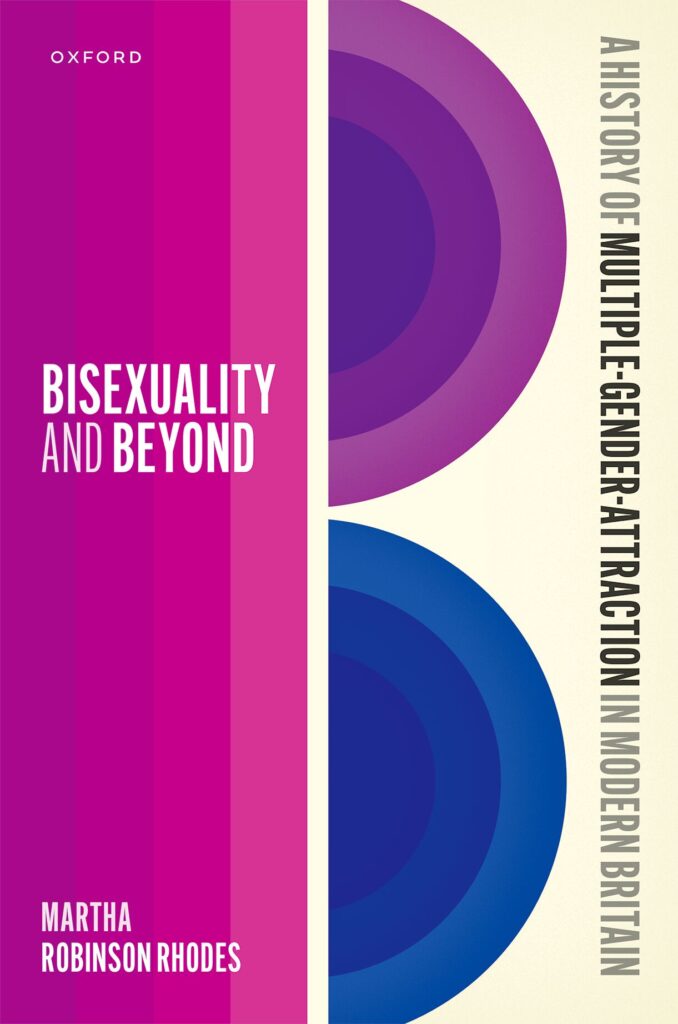
Oxford: Oxford University Press, 2026, 208pp, £88.00, hardback, ISBN: 9780198983125
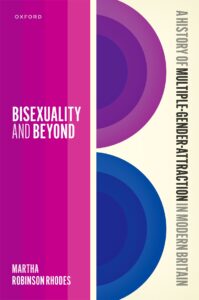
LGBTQ+ oral history is flourishing in Britain. Books, articles and special issues considering the particularities of queer oral history have steadily contributed to the corpus of oral history theory and practice in recent years, often authored by members of the Oral History Society’s LGBTQ+ special interest group. Bisexuality and Beyond is the latest of this growing list, and it makes a significant contribution.
Based on her doctoral research at the University of Birmingham, Robinson Rhodes’ study not only centres bisexuality but, in doing so, suggests a radical reconsidering of queer history in late twentieth-century Britain. Far from being defined by a radical politics of acceptance, inclusivity and sexual heterodoxy, Robinson Rhodes demonstrates that radical lesbian and gay movements from the 1970s onwards were inherently exclusionary when it came to bisexuals. This is best seen in the March 1985 decision of the London Lesbian and Gay Centre to ban bisexual groups from meeting on its premises. Such exclusion was anchored in a sexual binary between (radical) homosexuality and (reactionary) heterosexuality — the functioning logic of radical lesbian and gay groups during the period. Attending to the history of bisexuality, Robinson Rhodes suggests, allows us to rethink the liberatory politics of such movements, shedding new light on queer British histories.
In part, bisexuality and bisexuals have received less attention from historians of sexuality due to the reality that there was a less formally codified political community organised around a ‘bisexual’ identity. To be sure, this is a core element of Bisexuality and Beyond. Robinson Rhodes is clear: ‘Bisexuals in late-twentieth-century Britain were unable to articulate a coherent politics of identity’ (172). Despite this, attempts to mobilise a bisexual movement have a particular history in Britain. For example, formal conferences on bisexuality were held in London six years earlier than in the United States, suggesting a very different direction of political travel than we are used to reading in queer histories.
This ambivalence around identity could have been a major obstacle to a study such as this, rooted as it is in oral history. To mitigate this, Robinson Rhodes mobilised the term ‘multiple-gender-attraction’ in an attempt to capture those who may experience sexual or romantic attraction to a variety of gender identities but reject bisexuality as a label. In doing so, Robinson Rhodes offers a methodological framework to better attend to ‘narratives that were incoherent, disjointed, or partial’ (20), one which will be of use to oral historians working on a variety of subjects.
Oral history interviews animate this book’s narrative and analysis. Robinson Rhodes deploys a fascinating and original array of interview material. Her own interviews, conducted between 2018 and 2020, are put in conversation with the oral history interviews conducted in the 1980s and 1990s as part of the Hall-Carpenter project. These interviews were organised around ‘gay and lesbian history’ and, as such, there is less direct engagement with bisexuality as a formal identity. However, they provide a fascinating and productive insight into the ways in which attraction to multiple genders was articulated and composed thirty to forty years before Robinson Rhodes sat down with her interviewees. Robinson Rhodes also draws on the published work of Charlotte Wolff, the psychotherapist who produced the first book-length study of bisexuality in Britain. Her 1977 book Bisexuality: A Study was informed by ‘questionnaires, interviews, and autobiographical sketches from seventy-five male and seventy-five female bisexual participants’ (12). In addition to rich archival material, these interviews provide remarkable insight into the ways in which bisexuality and multiple gender attraction has been understood, remembered and articulated across the last fifty years.
Robinson Rhodes uses these sources to great effect. Chapter 5, for example, considers the place of the ‘coming out narrative’ in bisexual oral histories. Critiqued as a predominantly white narrative, stories of coming out – publicly declaring one’s queerness, usually to a straight audience – has occupied a major place in queer oral history scholarship. Bisexuality and Beyond makes an original contribution to this literature by highlighting major differences in bisexual narratives of coming out. Coming out was not a dominant feature of the interviews which inform this book, most of which ‘did not structure their life narratives around teleological stories’ of disclosure (163). Instead, interviewees deployed ‘non-linear narratives of identity’ (168) in which they may have identified as straight, then gay, then straight again, depending on their changing political, personal and romantic realities. Others simply refused to be drawn on the matter. At times, these were evident through moments of discomposure but, generally, Robinson Rhodes argues that bisexuals and ‘those attracted to multiple genders resisted the “disclosure imperative”’ consistently from the 1970s to the 2020s (137). Her deft use of original and archived oral histories makes visible this history of continuity, one which differs markedly from dominant histories of coming out.
Bisexuality and Beyond makes a significant contribution to the history of sexuality in modern Britain, as well as to oral history literature. It intervenes productively in debates about identity and queer oral history in particular. It should be read widely by oral historians as an example of a book which deals expertly with identities and memories which do not fit easily into dominant cultural, political and personal frameworks. As Robinson Rhodes shows, not only can such narratives lead to innovative methodological developments, they can also reframe the histories we are working in more broadly.