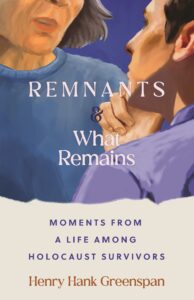
By Henry Hank Greenspan. Detroit: Wayne State University, 2025, 128 pp, £18.99, paperback, IBSN-10: 0814352632
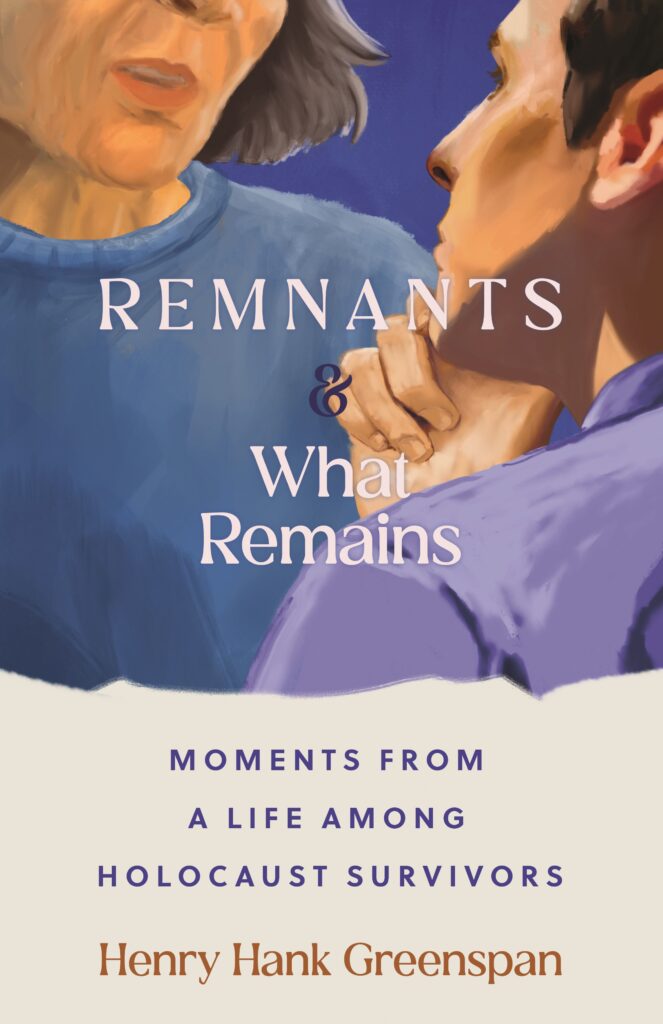
Remnants & What Remains: Moments from a Life among Holocaust Survivors is a remarkable memoir that chronicles Henry ‘Hank’ Greenspan’s personal, intellectual, and creative journey through more than five decades of conversations and collaborations with Holocaust survivors. The volume includes the first print publication of his acclaimed voice play REMNANTS, performed on more than 300 stages worldwide, alongside reflective essays on its creation and on the relationships that made it possible. The book offers insight into Greenspan’s pioneering contributions to oral history and Holocaust studies.
The publication is noteworthy not only because it makes REMNANTS available in print for the first time, but also because it provides a rare opportunity to understand the relational and methodological foundations from which the play emerged. In the opening chapters, Greenspan recounts his work with Holocaust survivors and the circumstances that eventually led him to write REMNANTS. The first version of the play was produced for radio in 1991 and was explicitly subtitled ‘A Voice Play’. Although it has since been adapted for stages around the world, it remains fundamentally a voice play. Greenspan’s work, and the play itself, are concerned as much with how survivors tell their stories as with what they tell. Attention is directed not only to the content of testimony but also to cadence, repetition, hesitation, humor, contradiction, and silence: to the ways survivors construct an account as much as the account itself.
One of the most engaging aspects of the memoir is Greenspan’s account of how his conversations with survivors began in the 1970s. At the time, he had no intention of creating a theatrical work. The conversations were initiated for research purposes and developed over many years without any expectation that they would become a play. It was only two decades later, when a student suggested transforming the material into a dramatic performance, that the idea of REMNANTSemerged. Significantly, the play itself was born of a relationship, the encounter between teacher and student, and an emphasis on the relational dimensions of knowledge production runs throughout Greenspan’s work. Ideas, practices, and insights, Greenspan reminds us, often emerge through human encounters.
The same can be said of the methodological innovation for which Greenspan has become renowned. Within both oral history and Holocaust studies, his practice of sustained conversations conducted over many years has been groundbreaking. Yet, as Greenspan reminds us, even this practice did not originate solely with him. Rather, it emerged from his interactions with survivors themselves. Many encouraged him to return, saying some version of: ‘Come back next week; we’ll talk again; we’ll talk some more.’ As Greenspan writes, ‘And so we did, creating practice together’ (p 4). This observation encapsulates one of the book’s central arguments: oral history is not simply a method applied by researchers to interviewees. Rather, it is a collaborative practice, continuously shaped by all those involved.
Greenspan’s reflections on listening are among the most theoretically and methodologically significant sections of the book. Sustained conversations allowed him to revisit his recordings between meetings, a process he describes as ‘listening to the listening’ (p 4). By repeatedly returning to recordings and undertaking all transcription work himself, Greenspan developed a deeper understanding not only of survivors’ narratives but also of his own role as listener. This process of relistening became fundamental to what he calls his efforts to ‘hear survivors well’ (p 4). As he notes, when he eventually came to write a voice play, he possessed ‘an orchestra of distinct voices’ from which to draw (p 4).
Over time, Greenspan expanded this practice further, bringing transcripts and excerpts from earlier interviews back into later conversations. Together with survivors, he revisited previous accounts, clarifying, reconsidering, and expanding them. Beyond clarification, these encounters often generated new memories and fresh insights that had not occurred in earlier conversations. Greenspan refers to this collaborative process as ‘learning together’ (p 5), a phrase inspired by one of his closest conversation partners, Agi Rubin, with whom he remained in conversation for more than forty years. Learning together became a methodological principle that grounded the collaboration between the survivors and Greenspan. In doing so, it challenged conventional assumptions about interviews as one-time acts of extraction and instead positioned oral history as an ongoing, shared process of reflection.
Throughout the memoir, the listener occupies a central place. Greenspan repeatedly returns to survivors’ experiences of being heard, misheard, ignored, or understood, but also on the survivor’s perception of our perception of them. His scholarly and dramatic writing alike foreground the relationship between the survivors and the audience. In this respect, the book makes an important contribution not only to Holocaust studies but also to oral history. Practices such as ‘listening to the listening’, ‘learning together’, and sustained attention to survivors’ experiences of listeners and publics represent some of Greenspan’s most enduring methodological contributions. They remind us that oral history is fundamentally concerned with relationships and with the ethical responsibilities that emerge from them.
As oral historians, we have much to learn from Greenspan and from the survivors with whom he has been in dialogue for several decades. Their conversations are part of what remains, but so too are the practices they developed together. The book is therefore not simply a memoir, nor merely the publication of a celebrated play. It is also a reflection on a lifetime of collaborative inquiry and on the possibilities of listening as a scholarly, ethical, and creative practice. At the same time, it is a book about loss and grief. In the final chapter, Greenspan reflects on both the survivors’ ageing and his own, and on what it meant to outlive many of the people with whom he had shared decades of conversation, ultimately confronting the loss of those whose voices and lives had shaped his work and life.
Within Holocaust studies, scholars often ask what we can learn from survivors and what legacies they leave behind. Greenspan’s answer is both simple and profound: we can learn a great deal, especially when we learn with survivors rather than merely from them. Regarding legacy, the book argues that legacies cannot be controlled by those who leave them behind. As one of Hank Greenspan’s long-time conversation partners and friends, Agi Rubin, observes: ‘In the end, my legacy is not up to me. It is up to whoever comes after, to pick up this bit, remember that part … as it may apply to their own circumstances’ (p 3). The same may be said of Greenspan’s own work. He has left us not only with conversations and with REMNANTS, but also with a set of intellectual and methodological practices. What remains is for others to take them up, adapt them, and carry them forward in their own research, teaching, and creative work. In that sense, REMNANTS & What Remains is both a reflection on what endures and an invitation to future generations of oral historians to continue the conversation.