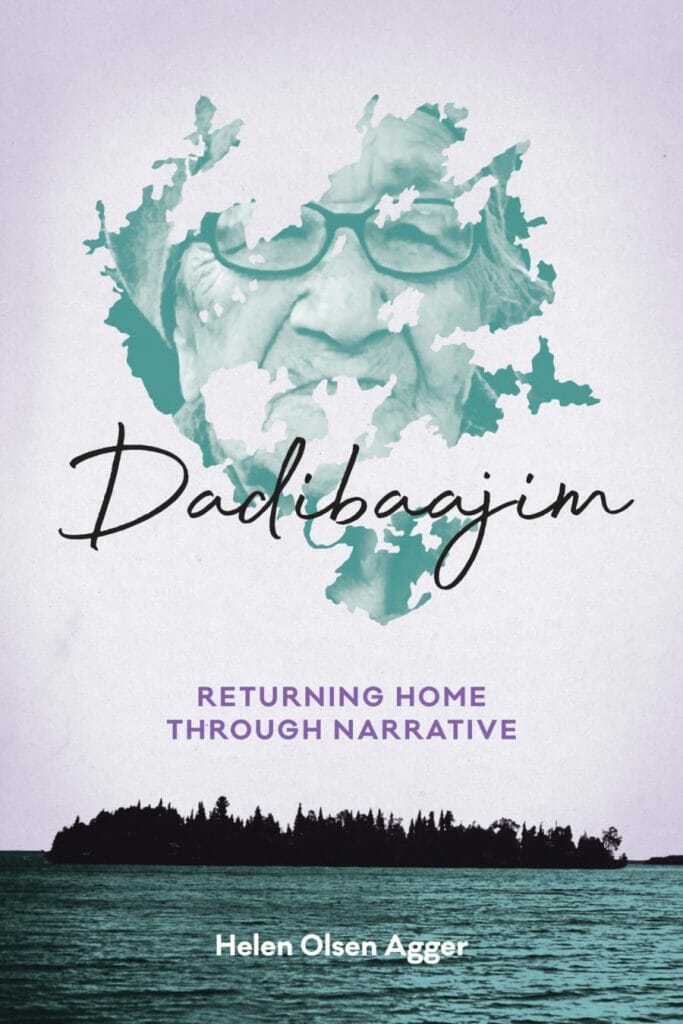
By Helen Olsen Agger
Winnipeg: University of Manitoba Press, 2021, 272 pp, paperback £18.31; ebook £16.40
Helen Olsen Agger begins this beautifully written and at times heart-wrenching book by saying that as a child, she had the privilege of listening to her mother, Dedibaayaanimanook’s, dadibaajim, or oral narratives, in Anishinaabemowin. These narratives are primarily from the land. It was only years later that Agger came to understand the full wisdom of these oral narratives. Dadibaajim was the way Elders taught their children; it was the way the Elders transmitted their insights, knowledge and teachings from one generation to the next. Dadibaajim narratives today are crucial in discussing identity of the Namegosibii Anishinaabe people.
This book is a huge contribution to the historical literature, as Agger points that ‘next to nothing has focused on the Namegosibii (Trout Lake) Anishinaabeg’ (p2) peoples who traditionally lived in northwestern Ontario, Canada. Their lands also include those around Wanamani-zaa’igan (Red Lake), Namegosibii Shishiing (Little Trout Lake), Baagwaashiwi-zaa’iganiins (Bruce Lake), Baagwaashiwi-zaa’igan (Pakwash Lake) and Obizhigokaawi-zaa’igan (Lac Seul Lake). Maps in the book provide good illustrations as to these locations for the reader.
One of the many strengths of this book is the extensive use of Anishinaabemowin, a language that is no longer spoken widely today due to colonialisation. On the first page of the preface Agger tells the reader that her ‘extensive use of Anishinaabemowin may at first seem jarring’ and I admit it was at first. To help the non-Anishinaabemowin speaker, the book contains a glossary of Namegosibii Anishinaabemowin terms which I would urge readers to peruse first before embarking on reading the book in order to familiarise themselves with their meaning. I found it particularly helpful to print this out and have it beside me while reading the book for easy reference to the various Anishinaabemowin words encountered in the book. After a few chapters I found I recognised the terms and understood their meaning in the context of the author’s narrative. Also in her preface, Agger goes into detail about the linguistic details of the language, its sounds and its pronunciation in English, which effectively augmented the guidance offered by the glossary.
As with all oral narrative, context is crucial to understanding and as Agger argues, so is language, thus the heavy use and excellent discussion of Anishinaabemowin, particularly of how various words are composed and what they mean. The first few chapters are devoted to giving the reader historical context to what will be discussed in the dadibaajim narratives as told by eight community members that are the foundation of the book. Together these eight narrators share their description of the land, their teachings, events and their belief systems which coalesce into what it means to be Namegosibii Anishinaabeg. Agger walks us through the effects that the arrival of wemitigoozhiway (Europeans) had on the Namegosibii Anishinaabe people and their landscape. She discusses the history of Treaty #3 1Treaty #3, also known as the North-West Angle Treaty, was signed on October 3 1873 by some Saulteaux (Ojibwe) people and the Government of Canada. An adhesion to the treaty was made in June 1874. When signed, the homeland territories of the Namegosibii Anishinaabeg along with those of Obizhigokaang and Sturgeon Lake, 55,00 square miles, became Crown Land. and of conservation and nature reserves brought about by what is now the Ontario Ministry of Natural Resources and Forestry, and through the heart wrenching destruction of the homelands through mining and damming of rivers, submerging sacred sites and trails and camps. She addresses the generational effects of residential schooling and all the effects of colonisation that led to the increasing loss of Namegosibii Anishinaabeg identity.
The author holds a unique position to frame the dadibaajims. She learned Anishinaabemowin at an early age, she is a member of the Namegosibii Anishinaabe community and she traces her maternal ancestry back to her great-grandfather Giizhig and great-grandmother Moonz(h)oniikwe. Effective figures in the book denote the relationships among the participants depicted as tap roots from a main root of a tree of Giizhig and Moonz(h)oniikwe. Using this figure as reference when reading the book was very helpful in keeping the descendants of the authors great-grandparents straight in my mind and recalling what position they occupied in the overall family tree while reading their dadibaajims.
Aggar relies on the dadbaajims of eight Namegosibii Anishinaabemowin members in this book. She organises the participants into three sections. In the first group is Aggar’s mother, Dedibaayaaimanook Sarah Keesick Olsen, who is the eldest of the eight participants. Born in 1922, she is the author’s last direct link to the ontologies of her ancestors and shares her powerful and vivid memories of the life she once lived on the land. Oo’oons John Paul Kejick spoke Anishinaabemowin, and although he attended boarding school and lived much of his life in town rather than on the homelands, he recalls portions of the dadbaajim narratives. Gwiishkwa’oo Eliza Angeconeb too speaks her language fluently despite attending boarding school. As a child she and her family still followed the customary journeys throughout their homelands. The second group is made up of the next generation, Niinzhoode Wilfred Kejick, William King and Martha Ageconeb Fiddler. The third group of two is made up of Martha’s daughters, Jane Fiddler and Riel Olsen, the great-great-grandson of Giizhig. They are not fluent Anishinaabemowin speakers but understand the basics of the language. In each generation we can see the increased colonising influences of the dominant language of English, public schooling and living lives in urban centres.
With the context set, halfway through the book we are introduced to dadibaajim from the senior elders whose ‘ancestral voice emerge to describe perspectives of life prior to the advent of wemitigoozhi’s all-encompossing domination’ (p105). As Aggar notes, the dadbaajim speak to a landscape that barely exists today. The boreal forest narratives speak to a time of life on the land, trapping, travelling and are full of place names where the people lived throughout the various seasons. Again, a detailed map helps the reader navigate the canoe route noting places discussed in the dadbaajim. The descriptions of the land, water, trails, lakes and islands, seasonal activities and traditional land use gives the reader a real sense of home in the boreal landscape, a way of life that quickly disappeared with the encroachment of wemitigoozhiiwaadiziwin.
Aggar then moves the discussion into one of colonial identity. The dadibaajim detail the direct and swift experiences of how colonialism impacted daily lives. These narratives are heartwrenching at times, such as when describing the massive negative effects of the flooding of homelands when a hydro-electric dam was erected. The final chapter of the book engages with various historical texts to retrace some of the information about the family trees and roots that appeared in the book.
Aggar has justly won several awards for this book.2Honorable Mention, Labriola Center American Indian National Book Award (2021); Winner, Indigenous History Book Prize, Canadian Historical Association (2022); Winner, Ontario CLIO Prize, Canadian Historical Association (2022); Winner, Alexander Kennedy Isbister Award for Non-Fiction, Manitoba Book Awards (2022) I would highly recommend it to anyone who looking to read a text that written in a way that embraces an Indigenous language and reclaims identity, history and fills the void in the literature about the Namegosibii Anishinaabe.
Footnotes
- 1Treaty #3, also known as the North-West Angle Treaty, was signed on October 3 1873 by some Saulteaux (Ojibwe) people and the Government of Canada. An adhesion to the treaty was made in June 1874. When signed, the homeland territories of the Namegosibii Anishinaabeg along with those of Obizhigokaang and Sturgeon Lake, 55,00 square miles, became Crown Land. ↩︎
- 2Honorable Mention, Labriola Center American Indian National Book Award (2021); Winner, Indigenous History Book Prize, Canadian Historical Association (2022); Winner, Ontario CLIO Prize, Canadian Historical Association (2022); Winner, Alexander Kennedy Isbister Award for Non-Fiction, Manitoba Book Awards (2022) ↩︎