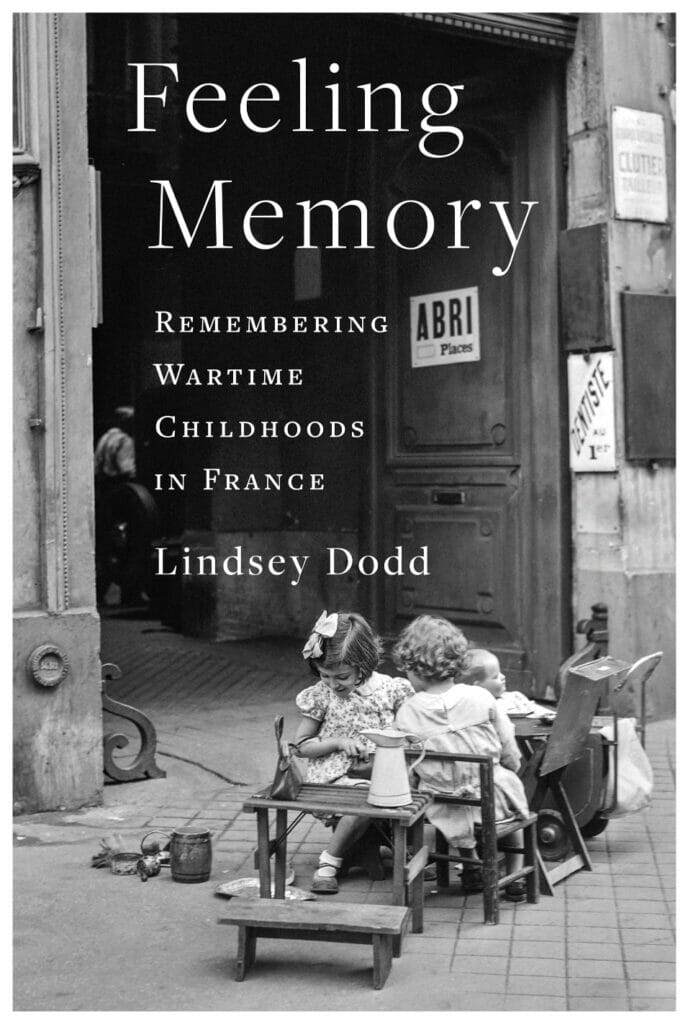
by Lindsey Dodd
Columbia University Press, 2023, 375pp, £30, paperback
In the introduction to Feeling Memory, Lindsey Dodd emphasises that this book is not a conventional overview of childhood in France during World War II. Rather, she is trying to answer two questions. The first is to understand what it was like to be a child during the war. The second is ‘how can we, as historians, get at that experience “from the inside out?”’ In other words, she is interested in how children felt and experienced the war. I would add a third question: how do people who were children during World War II remember the war? To answer these questions, Dodd draws on oral histories she has collected, as well as an impressive number of recorded interviews she located in French archives. She uses these oral histories to address larger methodical questions related to collecting and using oral histories. She is particularly interested in the role feeling and affect played in how her subjects formed and recalled memories.
Dodd is adamant that she is not writing a standard historical monograph. In her literature review and throughout the book, she engages more with scholars of memory or of emotion than with historians of World War II. The book is also less argument-driven than a traditional history monograph. Instead, Dodd centres the oral histories. She includes ten ‘pauses’ throughout the book. In each pause, she details the story of a particular interviewee. She uses each pause to illustrate a particular point. She also uses to pauses to showcase the rich details in the oral histories.
Dodd divides her book into four parts: Memories Felt, Memories Located, Memories Told and Memories Lived. In Memories Felt, she first looks at the centrality of feelings in memories. She is interested both in sensory experiences, such as the sound of bombs, and emotional experiences, such as the sensation of fear. She emphasises that paying attention to sensory details helps to provide a logic to the messiness of memories. In Part II, Memories Located, she considers the ways in which strong emotions might affect how interviewees represented time and space in their recollections.
The two chapters in Part III, Memories Told, stood out as valuable reading material for aspiring students of oral history. They both provide important observations about how to read oral histories as historical sources, but also important considerations when collecting oral histories. In Part III, Dodd looks at ‘vertical operational regimes of memory.’ Since World War II, historians have debated the role of ordinary French people in collaborating with the Nazi regime. Dodd examines how interviewees engaged with the now official narrative of the war. She then turns to the ‘horizontal operational regimes of memory.’ By this, she means the various audiences interviewees might be responding to. As they share their experiences, an interviewee responds to a real or imagined audience. In some cases, people participated in group interviews. For instance, a husband and wife might sit for an interview together. The conversation between the two changed how each relayed his or her memory.
The final Part, Memories Lived, returns to her first question about the lived experiences of the war. This section most closely approximates a more traditional history of childhood during World War II. Here, Dodd discusses food and clothing shortages. She examines how interviewees discussed their relationships to the German army or to their own parents. Finally, she studies the most cataclysmic moments of the war: the outbreak in 1939-1940 and the Liberation of France in 1944-1945. She wants to highlight how individual interviewees experienced these events. In some cases, she shows that their individual experiences might deviate from the more conventional history of these events.
Dodd has assembled an impressive collection of oral histories. The appendix at the end of the book includes interviews with 120 different people. Fifty-two of the interviews are from her own research on the Allied bombardments of France during World War II and on the evacuation of children to the Creuse. To collect the other interviews, she reached out to every single departmental and municipal archive in France to see if they had any kind of oral history with someone who had been a child in World War II. I appreciated how she gave equal balance to the two sets of oral histories. She not only uses examples from the archival oral histories to support her argument through the text, but also devotes a number of the pauses to these oral histories.
The drawback in using such a wide-ranging collection of oral histories is that they are diverse. The earliest is from 1982 and the most recent are from 2017. One interview consists of a Jewish survivor speaking to a classroom. Others were specially collected for a project on the history of the French railway during World War II. Dodd does acknowledge these differences in the introduction. But I wonder if she could have engaged with some of these differences in some of the other chapters. When she discusses the presence of emotions in Part I, I wondered if interviewees’ emotions were stronger based on the type of audience they were addressing or based on the time elapsed since the war.
Dodd’s conclusions are valuable for all scholars of childhood and not simply those who work with oral histories. Many of the patterns she identifies also appear in French children’s written responses to World War I. In the 1920s, the schools around Lille asked children to write about their memories of World War I. As in the interviews Dodd studies, the children frequently talked about hunger. Their responses contain strong, evocative emotions. Certainly, many of the issues Dodd raises about the mechanics of oral histories are unique to these types of sources. But her careful reading of these sources will be instructive to all scholars of childhood.
Dodd’s choice to make this book more about method means that it will appeal to historians beyond specialists of French history. In this book, childhood in World War II serves as a case study to explore many of the fundamental challenges of conducting oral histories. This book will be of interest to a wide range of oral historians. She anticipates this audience, as she makes sure to provide enough background on people or events for those who might not be familiar with French history. Although some of the more theoretical material in the earlier chapters might be challenging for undergraduate students, this is definitely a book that will be helpful to scholars of oral history at any stage of their career.