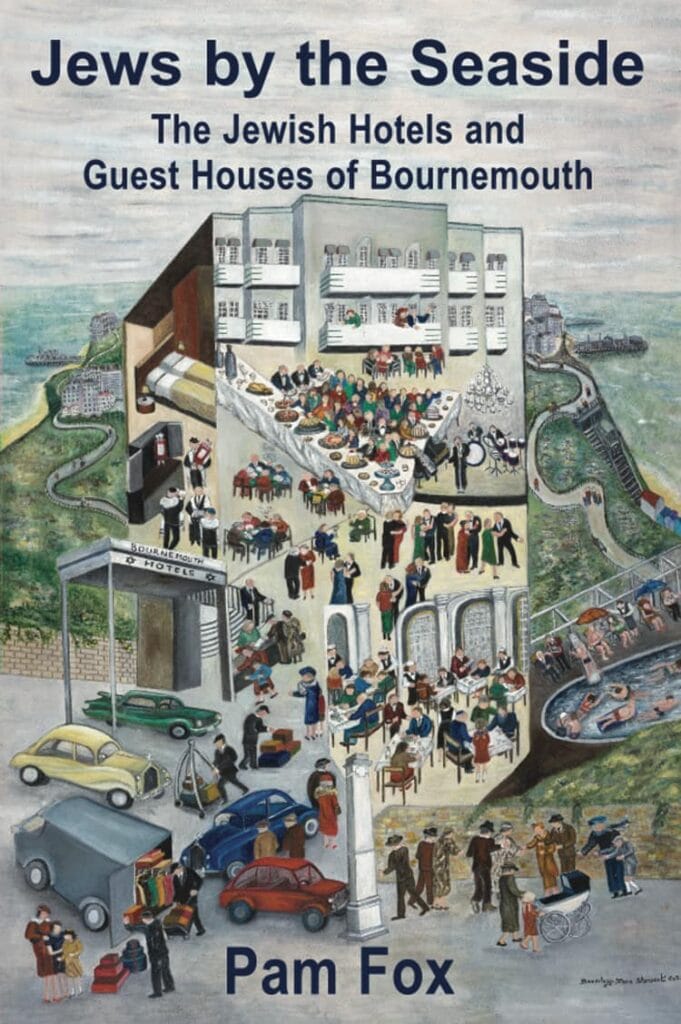
by Pam Fox
Valentine Mitchell, 2022, 400pp, £19.95, softback
Pam Fox’s informative, well-researched and entertaining book provides a detailed picture of Jewish holidaymaking at Bournemouth, and the guesthouses and hotels that have hosted varying numbers of visitors over the past century. The detail comes from an extensive review of the Jewish Chronicle, a wide range of other published material, and perhaps most significantly over 100 interviews since 2010 with people who stayed in, worked in or ran the hotels and guesthouses used by Jewish holidaymakers. As well as providing a wealth of detail, the oral history also supplies considerable colour and at times humorous anecdotes about the holidaymakers and their holiday habits during the twentieth century.
Following a brief initial chapter on the early history of Jewish holiday accommodation in Bournemouth, Fox reviews the hotels and guesthouses from 1914 to the present day. In part two of the book, she focuses more on details about life in the hotels and guesthouses, ranging from food and catering, the practice of religion, as well as the entertainment, recreation and relaxation available for visitors. She concludes by examining the relationship between the Jewish hotels in the town of Bournemouth and considers their important legacy. The author should be commended for the excellent glossary at the beginning of the book which helps the reader to understand the complex vocabulary of the Jewish faith and its practices.
The twentieth century was a challenging time for Jewish people and their story is told against the backdrop of the changing character and economic viability of English seaside resorts, and Bournemouth in particular. In taking the century from 1914 to the present day, Fox witnesses changes in holidaymakers and holiday habits resulting from the First and Second World Wars, and a rise in foreign competition facilitated by greater accessibility not to the Mediterranean in general but more specifically to Israel. With COVID-19, limited access to families and properties in Israel witnessed some resurgence of interest in visiting Bournemouth, though mostly now to non-kosher hotels or self-catering accommodation.
Fox tracks how different parts of the Jewish community at various times enjoyed Bournemouth and its hotels as holiday destinations; she also documents how they could enjoy being part of their faith group and thus still conduct their religious practices. She examines how Jewish holiday accommodation managed the provision of kosher food but also at times was a place for more or less strict religious observance, including the provision of services for the sabbath at some hotels. Fox illustrates how each of the larger hotels formed a community, providing facilities, nightly entertainment and events on special occasions, meaning that visitors old and young scarcely needed to leave the hotel.
Books appeal to readers in different ways and for this reviewer what chimed particularly was the past formality of hotel life in mid-century Bournemouth. As an annual visitor to rural Scottish hydro hotels for Hogmanay, the stories in this book about formal meals and the agonising decisions about dressing up reminded me of my own holiday past. How formally should one dress for meals is a rare consideration today, but Fox has some hilarious oral evidence concerning how much time was invested in this subject. ‘At that time, it was said that Green Park guests dressed as well as any of those to be seen in Claridge’s and other luxury hotels in London. The hotel was known for its daily fashion parades. Many of the guests worked in the clothing trade and had ready access to smart and fashionable attire’ (p 82). Fox goes on to recount an amusing conversation between a husband and wife; the latter was agonising over dressing in Dior or Balmain, and whether to choose a red or blonde wig, with diamonds or rubies. The hilarity of this conversation comes from the last line of Fox’s quote where the husband says: ‘Your rubies. But hurry up we’ll be late for breakfast!’ (p 82).
Fox’s research is to be commended, and although her book is a long and at times very detailed examination of Jewish holidaymaking in Bournemouth, it is a valuable piece of work about Britain’s leading destination for Jewish holidaymakers. She also points out that Bournemouth was one of Europe’s most intact Jewish communities after the Second World War, even if only for parts of each year, as it had not suffered from Nazi occupation. Although provision for Jewish holidaymakers declined in the later years of the twentieth century, leading to hotel closures or conversions to non-Kosher establishments, this aspect of the town’s holiday history has left behind significant physical heritage.