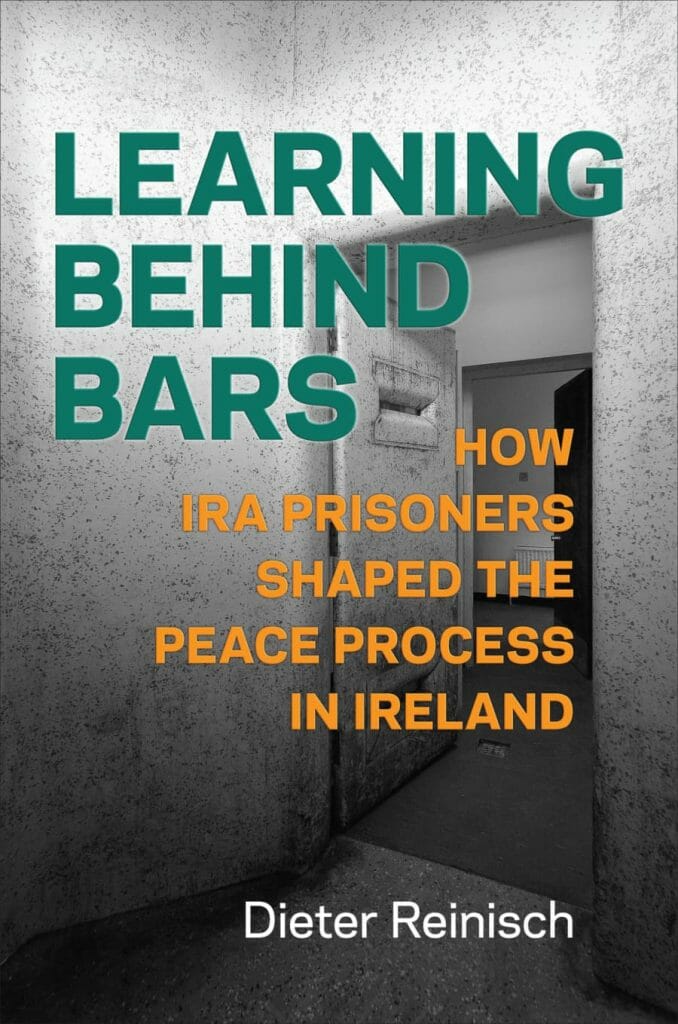
by Dieter Reinisch
Toronto: University of Toronto Press, 2022, 240pp, $70.00 (£56), hardback
According to an authoritative estimate, some 15,000 Irish republicans were imprisoned during the Northern Ireland conflict from 1969. Engaging a wide range of republican interview partners, Dieter Reinisch has generated new insights into the movement’s internal dynamics, especially among its prisoners, from the 1970s to the 1990s. Reinisch examines in detail how jailed republicans adapted to their environments in Ireland north and south, and how they formed and managed their politically committed communities. The book’s sensitivity to ideological and strategic contestation within the movement – which Reinisch accesses predominantly via activist retrospectives – represents its greatest strength.
Oral histories have significantly enhanced analyses of Irish republicanism after 1969, when ‘the troubles’ erupted in Northern Ireland. To name but a few, Rogelio Alonso, Kevin Bean, Richard English, Marisa McGlinchey, Graham Spencer, Robert W. White, Sophie A. Whiting, and the present reviewer have produced monographs drawing upon interviews to explore the republican movement’s dynamic heterogeneity. These studies have analysed the movement’s controversial trajectory from the military primacy of the IRA’s ‘armed struggle’ in the 1970s to Sinn Féin’s exclusively constitutional strategy in the twenty-first century. Connecting prisoners’ educational pursuits to their perspectives on the movement’s overarching direction, Learning behind bars sits firmly within that body of analytical work.
For all that they illuminate, oral histories of contemporary Irish republicanism have often drawn upon a similar interview cohort, usually comprising the most prominent strategists who pioneered Sinn Féin’s constitutional turn under Gerry Adams’s leadership. As Stephen Hopkins has noted, these retrospectives form a distinct narrative type, justifying the transition from armed struggle to constitutionalism while upholding the guerrilla campaign’s historical legitimacy. Moreover, in depicting a consensual strategic shift, these versions generally downplay intra-movement disagreement. Conversely, dissenting perspectives underpinned the ingenuity of works by, inter alia, McGlinchey and White, who both featured testimonies from activists who had left the Provisional movement during its long march from militarism to parliamentary politics.
Happily, Learning behind bars is among the select few books to draw upon an array of interviews not confined to the more routine Sinn Féin coterie. Through painstaking research, Reinisch has amassed a striking sample of more than forty interviews. While many do not appear directly in the text, the book certainly benefits from the variety of perspectives across different republican organisations and networks. Given Reinisch’s earlier published works include oral histories of republican women’s networks such as Cumann na mBan, the women imprisoned in Armagh and Maghaberry are an unfortunate omission here.These cohorts protested against criminalisation and strip-searching, and in the 1990s the Maghaberry prisoners evinced critical perspectives on what Sinn Féin termed its ‘Irish peace initiative’ – the peace process which forms the basis of Reinisch’s final chapter.
As a corollary of the geographical breadth of Reinisch’s interview sample, Learning behind bars illuminates prison experience at the centre and the periphery of the republican movement. The book encompasses both the smaller prison populations in the Republic of Ireland, as well as the more intensely-studied republican wings in Long Kesh, where ten republicans died protesting for the right to be treated as special-category political prisoners in 1981. After IRA volunteer Bobby Sands won the Fermanagh-South Tyrone by-election in April 1981, five weeks into his hunger strike, the Provisionals began experimenting with electoral interventions.
The book’s opening chapters focus upon the republican prisoners in Portlaoise. Reinisch begins with the protests in Portlaoise in the mid-1970s, when prisoners resisted the criminalisation policy enshrined in the Dublin government’s Prison Acts, which hardened the treatment of ‘subversives’ (p40). Despite the final volume of Seán McConville’s panoptic trilogy, and Reinisch’s previous trailblazing articles, these struggles remain less familiar to historians than the anti-criminalisation campaigns in Long Kesh and Armagh in the late 1970s and early 1980s. Yet as Reinisch shows, the Portlaoise protests, including hunger strikes, bore tangible advances: from 1977, the new Fianna Fáil government ended strip-searches, liberalised lock-up rules, and allowed educational materials into cells (p53).
Deployed primarily as reconstruction devices, oral histories form the dominant evidential base for the discussion in Learning behind bars. Reinisch’s method is most rewarding when it recreates controversial episodes in the movement’s complex trajectory. He reconstructs, for example, historical debates concerning Sinn Féin’s controversial ard fheis (annual conference) of November 1986, when delegates voted to end the traditional policy of abstentionism in Dublin’s Leinster House, which republican orthodoxy cast as an illegitimate ‘partition parliament’. In retrospect, many commentators have identified the ard fheis of 1986 as an early staging post on the Provisionals’ path to an entirely constitutional strategy. At the time, the Adams leadership’s initiatives stimulated heated debate throughout the movement, including among prisoners. Reinisch’s forensic analysis delineates how influential prisoners on both sides of the argument developed their critiques. These recollections have an especially acute resonance among Reinisch’s interview partners, perhaps most notably Seosamh Ó Maoileoin: in 1986, Ó Maoileoin was an IRA prisoner in Portlaoise, where he disavowed the decision to drop abstentionism; in 2018, he was elected leader of Republican Sinn Féin, the pro-abstentionist rump which acrimoniously splintered from the Provisionals in 1986 (p77).
While unified in its broad thematic concern, Learning behind bars comprises two distinct parts. After an incisive introductory chapter and literature review, Reinisch has three chapters detailing anti-criminalisation protests and education initiatives among the Provisionals’ small band of prisoners in Portlaoise. The following three chapters shift the focus to the north. First, Reinisch examines the role of internees, especially around Gerry Adams’s Belfast circle, who envisioned a ‘long war’ of attrition from the late 1970s. Reinisch fuses archival analysis of the noted ‘Brownie’ articles – strategic critiques authored pseudonymously by Adams – with his interviewees’ subsequent hostility towards the veteran Sinn Féin leader. The combination helpfully illustrates how interviewees graft contemporary antipathies on to past jail experience. For instance, a longstanding critic of Adams’s premiership, Derry republican Michael Donnelly traces his hostility back to Adams’s lectures on Marxism in Cage 11 of Long Kesh in the 1970s. Adams, Donnelly alleges, ‘didn’t know what he was talking about. He was just rhyming off pages of it’ (p113).
The final two chapters deal with the political ferment in the H-blocks of Long Kesh after the hunger strike of 1981. Rendering a sophisticated analysis of the influence among prisoners of Marxism and international liberation movements, Chapter Six is the book’s finest. Reinisch proposes a valuable framework for conceptualising the jail’s complex ecology amid strategic review. Using differential approaches to education as an interpretive lens, he makes a compelling case for understanding IRA prisoners from the 1980s in tripartite terms, comprising a traditional, militarist position, most prevalent in the south; a ‘pragmatic’ faction, which incorporated socialist ideology but saw jail education in more functional terms, training a political class to govern the ‘new Ireland’; and a more doctrinaire, Marxist group around Tommy McKearney, who envisioned rigorous political education equipping a revolutionary Leninist vanguard (pp139-140). Reinisch skilfully connects these contrasting approaches to education to the broader disputes over strategic realignment.
Given the book’s panoramic chronological structure, its subtitle – ‘how IRA prisoners shaped the peace process’ – is a curious misnomer. Only the book’s final chapter deals directly with prisoners’ perspectives on the peace process of the 1990s – and its cardinal argument is that the republican leadership outside the jails peremptorily ‘consulted’ the prison population on a path that was already largely determined. The assertion is certainly justified, but it renders the book’s subtitle rather teleological, flattening the historical contingency of the Provisionals’ long and complex journey. The hunger strike of 1981, Reinisch avers, ‘changed Ireland forever’, setting the republican movement ‘on track to embrace electoral strategy’ and to endorse a ‘peace process’ (p131). But the path from electoral experimentation in the early 1980s to an exclusively constitutional strategy almost two decades later was tortuous, comprising many iterative, incremental steps. There is certainly a thread connecting the election of hunger strikers in 1981 and Sinn Féin’s support for the Good Friday Agreement of 1998 – but it is both tangled and frayed under the strain of intra-movement debate.
Reinisch’s reconstruction methodology is most successful when it elucidates these debates and tensions – and, implicitly, how they have been remembered and narrated. Since the majority of Reinisch’s substantial sample comprises individuals who have repudiated the Adams premiership over the past four decades, the second half of Learning behind bars especially substantiates a critical perspective on that leadership cadre’s machinations. Reproducing interview partners’ accounts, sometimes at length, Reinisch offers a window on points of disagreement among imprisoned comrades. For example, when Tommy McKearney recalls how he advocated an education programme in Long Kesh for a thoroughgoing Marxist analysis of the stalemate in the late 1980s, the reader gains valuable insights into how these disagreements corresponded to subsequent struggles for strategic authority in the republican movement (p128).
If the recovery method has a shortcoming in this instance, it is that the rich oral testimonies which Reinisch has elicited are surely apt for analysis through a Portellian framework of contested memory. Kerry ex-prisoner Matt Leen, for instance, remarks scathingly of his northern comrades that ‘some… didn’t know’ what their struggle ‘was all about’ (pp66-67). Seosamh Ó Ó Maoileoin, meanwhile, maintains that most prisoners favoured retaining abstentionism in 1986, but prominent individuals ‘manipulated’ debates within the jail on behalf of the IRA leadership outside (p88). Although his interview partners repeatedly mobilise specific versions of the past to partake in continual disputation, Reinisch generally refrains from contextualising these contentious claims in the ‘post-conflict’ moment. His spare analytical style has the advantage of enabling interviewees to speak for themselves and organically to imply propitious lines of inquiry. But to the extent that these polyvocal complexities resound through Learning behind bars, they are mainly implicit in the testimonies.
Nevertheless, with its chronological panorama, and the geographical and organisational range of its interview partners, Reinisch’s book offers a valuable perspective on the experiences of republican prisoners at the periphery of the movement. Furthermore, it provides a basis for analysing how debates on prison education connected to the wider struggle to determine the movement’s strategic direction. Although Reinisch adheres to a traditional method of ‘recovery’ oral history, his book is of undoubted value for scholars of the Northern Ireland conflict and, more broadly, for analysts of incarceration and the internal dynamics of militant social movements.