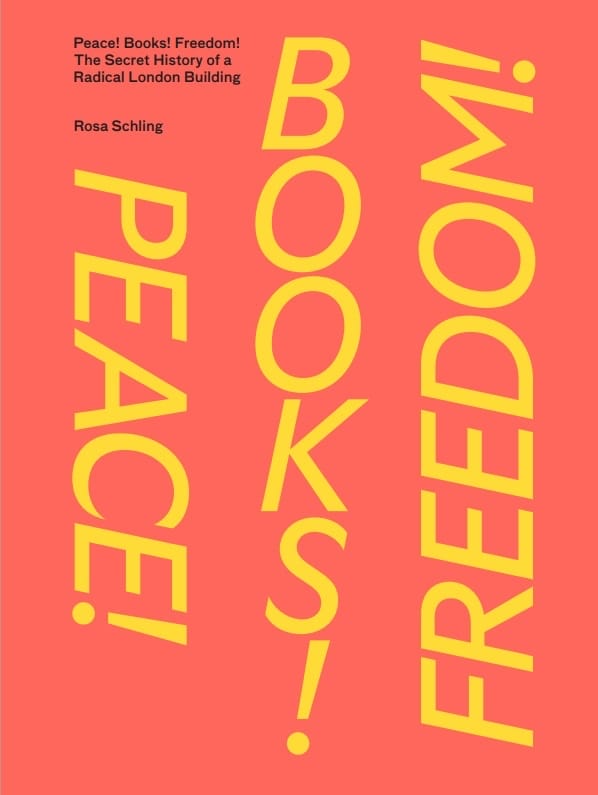
by Rosa Schling
(London: Housmans, 2023), pp190, £10.
Rosa Schling’s oral history of 5 Caledonian Road, Peace! Books! Freedom! The Secret History of a Radical London Building, cracks a window in a corner of central London that opens out onto the world. From the Cold War and looming fears of nuclear annihilation, to LGBTQ+ liberation, the Troubles in the north of Ireland, anti-globalisation protests in the 1990s and radical politics in the present, this beautifully-constructed and beautifully-written book knits together a global history with a profoundly placed and local one.
The building at 5 Caledonian Road, affectionately truncated by interviewees throughout as ‘5 Cally Road’, is probably best-known as the home of Housmans bookshop, a ‘movement’ shop selling an ecletic selection of radical literature (as well as quite a lot of office stationery, at least until the 1990s). Housmans opened in 1959 along with the pacifist newspaper Peace News, and has remained in the same building until the present day, a remarkable achievement in the context of the churning neoliberalisation of space in central London. As Schling’s account here suggests, it has been a ‘safe space to meet for many groups that may not have found a sympathetic home elsewhere […] not only those explicitly concerned with nonviolence, peace and anti-militarism but also LGBTQ+ organisations, environmental and animal rights, community and campaigning groups’ (p10).
Over eight chronological chapters, interrupted by two ‘archival sections’ composed of some scans of pamphlets and old photographs, the book draws on oral history interviews with around 40 people who worked and organised in or around the building over the course of the last 60 years. The interviews are used in a dispersed way across the narrative of the book, along with some archival material, to tell the history of the building in relation to the various activist currents that flowed through it.
What’s immediately striking about the book as you move through these chapters is its jumbling-together of voices, photographs, scans of Peace News and pamphlets from the Gay Liberation Front (GLF) – there’s a pleasingly tactile, collagist feeling to this mixture of materials which gives additional vividness to the oral history interviews as they’re used throughout. Ramsey Kanaan, an anarchist publisher and distributor, is quoted in the introduction as saying that ‘the main importance of Housmans is it actually exists as a physical space […] Housman’s remains an entryway and a gateway to a whole world of radical ideas, radical histories, radical potentialities’ (p11). To me it felt that the hodgepodge method used to compile the text was a powerful way of expressing this spatial juxtaposition on a formal level – placing the narrative history, the interviews and the images together evokes something of the complex spatial dynamics of the building itself, as well as its imbrication in both the local and the global. This spatiality is brought home especially sharply by the first and last few pages of the book, which are detailed black-and-white photographs of graffiti on the walls of the basement office used in 5 Caledonian Road by the GLF.
A further strength of the book, and one that’s made possible by its deft use of oral history interviews, is its apprehension of tension, discord and difficulty within the various collectives that have made use of 5 Caledonian Road. This is visible in editorial arguments within the Peace News collective and in debates within the bookshop’s management collective about stocking Class War’s strategically-inflammatory paper and the Irish republican newsletter An Poblacht; it is also an element of the interview with Rosie Ilett who criticises what she saw as the ‘esoteric […] kind of activism’ undertaken by Housmans and its affiliates, as opposed to ‘stuff that’s really linked to local communities’ (p123). As with the collagist method of presentation, this openeness to broaching and acknowledging disagreement helps to express something important about the history of the radical left which the book is sketching out via its microhistory of the building and its inhabitants over time.
Occasionally – as is perhaps unavoidable with a book that touches on so many large and small stories – I wanted to follow up on avenues that were pointed towards but not taken. I was intrigued, for instance, by the mention of Peace News editor Bob Overy’s two-year stint undertaking community activism in the Shankill in Belfast (p42). And the biographical snippets offered up in-text for each interviewee as they came up could have been collected somewhere in the book’s front or endnotes – as with the story about Bob Overy in the Shankill, these snippets gave tantalising glimpses of the lived experiences of the interviewees whose narratives are drawn on here without fully realising them. But given the book’s deliberately kaleidoscopic approach, a lack of detailed engagement with individual interviewees is understandable – it’s reassuring to know that the interviews themselves have been archived with the Bishopsgate Institute, and maybe further work could be done on these in time by historians working with a different lens.
The final bit of the book, Chapter Eight, uses a quote from current Housman’s bookseller Nik Górecki as its subtitle: ‘A Sense of Permanence’. As a whole, it’s that which comes through most strongly here – a sense of permanence attached and connected to a sense of flux, flow and change. Schling writes in the introduction that ‘through the diversity of [the interviewees’] recorded perspectives, we catch glimpses of the evolution of ideas and practices over time’ (p12), and each of the chapters gives a flavour of both those perspectives and of the shifting political and social landscapes they relate to. But the recalcitrant presence of 5 Caledonian Road, as a building and as a conduit for forms of critique, solidarity and organisation, means a feeling of permanence and of resistance cuts through and across this shifting history.
Peace! Books! Freedom! is an ideal monument to this mix of flux and permanence. It will be of interest to scholars of the radical left, to social historians of 20th century Britain, and to oral historians with aspirations to use their interviews outside of the traditional monograph or journal article format. Read in the context of the profoundly gloomy political climate of contemporary Britain, its juxtaposition and narration of sixty years of activist history felt refreshingly to me like what Raymond Williams called a resource of hope.