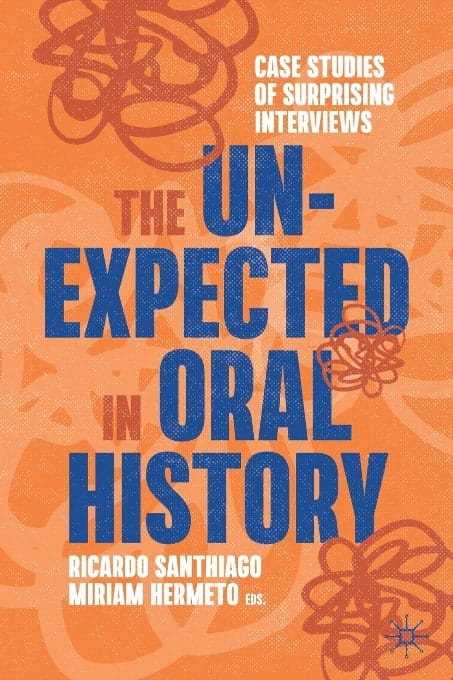
Ricardo Santhiago and Miriam Hermeto (eds)
Palgrave Macmillian, 2023, 274pp, £59.99
Most oral historians will be familiar with the potential difficulties and surprising revelations that can arise from encounters with the unexpected during interviews; as Jorge Eduardo Aceves Lozano writes in chapter eighteen of this collection, ‘the emergence of the unexpected is too common – what is rare is its absence’ (p 139). The new edited collection, The Unexpected in Oral History: Case Studies of Surprising Interviews (2023)casts a wide net in its definition of the unexpected, and the result is a book that will be relevant and useful to a broad range of oral history scholars. The examples drawn upon by contributors include departures from the intended topical or thematic scope of an interview, assumed or socially imposed identities that are complicated through narrative, the utilising and breaking of silences, and memories that appear to be invented. The collection is arranged according to methodological challenges rather than along thematic lines and each of the six sections are bookended by an introduction and a commentary, which helps to draw each set of chapters together.
In their introduction, editors Ricardo Santhiago and Miriam Hermeto suggest that many of the oral historian’s most formative and important experiences in the field come as the result of the differences between what the historian expects of an interview and what unfolds once the ‘record’ button is pressed. They argue that the unexpected elements of an interview, far from being a troubling inconvenience, ought instead to be viewed as a foundational and inherently valuable feature of the craft. Such experiences may in fact ‘not only redirect the steps of a given research project, but also often reconfigure the ethos of the researchers, destabilizing their hypothesis and certainties about their subjects and work methods’ (p 9). They believe that oral historians are shaped by those experiences that could be perceived as failings and argue that the impact of these experiences is as great, if not greater, than more run-of-the-mill, straightforward interviews.
The editors point out that discussions about these encounters with the unexpected often take place between oral historians in private. This collection seeks to highlight those conversations and extend them beyond the mere description of experiences and into the realm of theoretical and methodological discourse. Using thirty-five small chapters by various authors, each of which presents a case study featuring an element of the unexpected, the collection is largely successful in fostering a critical reflection on the unexpected as a common but under-researched theme in oral history practice.
In bringing these more private conversations to light, each of the collection’s contributors are necessarily required to respond reflexively to their experiences within the field and one of the key themes of the text is the deeply personal connection that many oral historians forge with their subjects. The result is a refreshingly open and honest set of chapters, with a particular highlight being chapter five, from oral historian Steven High. His contribution is a remarkable meditation on an interview exploring themes of childhood sexual violence, in which he considers the impact of his own childhood experiences on his practice as an oral historian. Initially hesitant to refer to his own experiences, High ‘resolved to include this personal context to help us understand the underlying dynamic’ of the interview (p 35). This acknowledgment of the central significance of interviewer’s subjectivity to oral history as a discipline is a uniting theme throughout the collection. As Daisy Perelmutter writes in chapter sixteen, oral historians are ‘enthusiasts of the craft involved in the production of our sources. Aware and zealous of its plasticity, we are both witnesses and agents of the multiple contingencies that affect its construction’ (p 121). The direct engagement with this element of oral history practice is another highlight of the collection.
The chapters in this text are somewhat brief but nonetheless effective in their explorations of the various ways in which the unexpected manifests in oral history interviews and would be useful case studies for introductory level oral history training and advanced practitioners alike. The text’s value lies particularly in the ease with which readers can dip in and out of the chapters, making use of them as starting points for further dialogue. Some chapters are rather dense and at times the collection’s focus on mainly Brazilian contexts can be a little difficult to follow for readers who are not specialists in that area, but this does not detract from the text’s overall value. The breadth of the interview themes at hand can also make the collection feel slightly disparate but this diversity is also something the editors argue is a strength, opening the collection ‘to a kind of unpredictability that we deliberately chose to keep, and that is expressed by the heterogeneity of themes, origins, assumptions, methodological practices, and theoretical framings’ (p 12) contained within. In other words, the broad-brush approach adopted by the editors in assembling the collection should perhaps be seen as echoing the multitudinous possibilities inherent in any oral history interview.
Throughout the collection, contributors consider how oral history requires a researcher to continually renegotiate their assumptions and expectations, to reflect on their own position in the interview space and to be consistently flexible in their methodological and theoretical approaches. Joana Barros does this with particular clarity in chapter thirty-one as she unpicks the methodological challenges she faced when interviewing unhoused individuals in São Paulo. Initially uncomfortable with the ways in which the circumstances of these interviews challenged her self-image as a ‘careful interviewer, compliant with the protocols recommended’, she concludes that the difficulties arose during the interview process because ‘my research questions and my attention to established research procedures collided with the concrete life’ of her interviewees (p227-8). It is powerful reflexivity such as this that is the overall collection’s greatest strength.
Confronting head-on the sometimes troubling but nonetheless extremely valuable experience of encountering the unexpected in oral history interviews, the collection is a celebratory consideration of the inherently intimate nature of the craft and the value of those elements that require the greatest dexterity and flexibility on the part of the interviewer, even if that value is sometimes hidden. Alessandro Portelli’s masterful afterword is an especially enjoyable read, highlighting above all the joy that can be found in oral history’s unpredictable and endlessly revelatory nature.