By Carla Pascoe Leahy
Manchester: Manchester University Press, 2023, 296pp, £85, hardback
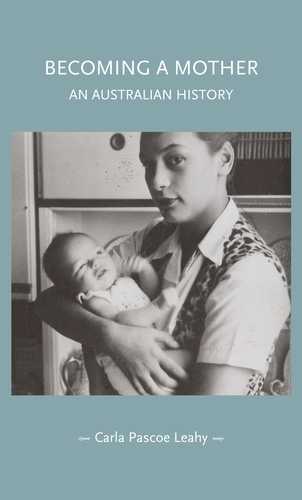
‘Once a mother always a mother’ is a well-worn phrase but, like so much about mothering, not well examined. At what point does one become a mother and how does this process of becoming a mother affect her sense of self, her family, and her community? How have previous generations of mothers experienced this transformation? In her sophisticated and beautifully written book, Becoming a Mother: An Australian History, Carla Pascoe Leahy explores how Australian mothers have experienced their transition to first-time motherhood since the mid-twentieth century. She addresses the ‘cloying sentimentality of the maternal ideal’ by arguing powerfully that the process of becoming a mother is ‘passionate, radical and transformative’ (p19). Pascoe Leahy’s book is the first of its kind to chart the history of mothering in Australia and in doing so challenges historical assumptions about motherhood and offers an alternate prism through which to read the life-altering experience of mothering and maternal memories.
Pascoe Leahy’s study is grounded in a commitment to ‘understanding mothering through the words and worlds of mothers themselves’ (p19) and draws on her sixty oral histories with a diverse sample of Australian mothers from three areas in the Australian state Victoria: inner-urban (Fitzroy), urban (Malvern) and regional (Ocean Grove). In addition to these co-created life stories, Pascoe Leahy employs extensive archival research, personal reflections gained from her embodied methodology, and interdisciplinary engagement with history, sociology, psychology and feminist theory, to demonstrate the major psychological and social transformation of becoming a mother within the context of historical change. Psychosocial theories such as Sara Ruddick’s ‘maternal thinking’, Alison Stone’s concept of the cyclical nature of ‘maternal time’, and Lisa Baraitser’s idea of the ‘unspeakable’ nature of mothering, shape her interpretative framework.
Pascoe Leahy goes beyond using interdisciplinary theories and methodologies. As she demonstrates, matrescence, or the period of becoming a mother, is a permanent shift, which affects maternal memories and how a mother tells her life story. Becoming a mother involves a psychological shift in identity and a re-formation of social relations. These changes and experiences happen within specific cultural and historical contexts, and they generate powerful emotions in the new mother. Pascoe Leahy convincingly argues that memories of the emotions and experiences of mothering ‘achieve a special luminosity in the mind’ (p28). So special that maternal life stories need to be understood within their own narrative framework. Expanding on Lynn Abrams’ concept of ‘feminography’ (a genre of women’s oral history narrative), Pascoe Leahy has developed a new term, ‘maternography’, to describe oral history narratives of mothering influenced by second-wave feminism, and to represent novel ways of understanding the historical significance of mothering. It is these rich and illuminating maternographies which form the heart of Becoming a Mother.
The book’s structure echoes the personal transition of becoming a mother. Instead of a chronological arrangement, it follows the journey to matrescence from conception and explores themes such as pregnancy, birth, paid and unpaid work and childrearing. There are five photos of mothers illustrating the three broad generations under study: postwar mothers (1945 to 1969), second wave mothers (1970s and 80s) and millennial mothers (transition from twentieth to twenty-first centuries.) I would have liked more images but understand the complexities and costs involved in incorporating these in scholarly publications.
Each chapter begins with a personal reflection on Pascoe Leay’s own maternography. This is where Becoming a Mothershines. Pascoe Leahy asked an oral historian to interview her about her matrescence. Sitting on the other side of the microphone of course allows an oral historian to better understand the interviewer-interviewee relationship and their researcher positionality. As a skilled and practiced oral historian Pascoe Leahy is acutely aware of the significance of the interviewer’s subjectivity to the process of conducting and interpreting oral history. However, she goes one step further— into territory not often taken by historians. She made the admirable decision to make herself ‘as vulnerable as my narrators’ by using extensive quotes from her own maternography throughout her book. This inversion of the interview relationship is not only an ethical decision but one that shapes and enriches her work enormously. Such a generous and innovative approach distinguishes her work and is perhaps a little underplayed. Pascoe Leahy’s methodological approach to self-interview could usefully be adopted by oral historians working in areas beyond the history of the family, as an additional tool offering ethical insights through intersubjective exchange.
As well as charting the continuities and changes in the transition to becoming a mother in Australia, Pascoe Leahy identifies important findings for contemporary industrialised societies. Pascoe Leahy calls for more social as well as practical support for mothers to prepare them for a ‘world of which she was not previously aware’ (p252). Instead of seeing maternal struggles as ‘individual pathology’, she points to structural problems especially around the lack of support for new mothers from health professionals, family, and the wider community. For example, maternographies highlight the complexities of mothers’ paid and unpaid work against a backdrop of shifting cultural ideals, economic structures, government policies and personal hopes and ambitions.
Pascoe Leahy began this project because she felt the historical accounts of motherhood were ‘impoverished and inadequate’ (p252). Her research ensures this is no longer the case. We now have a much better understanding of how women in Australia have experienced becoming a mother over the last seventy-five years. Becoming a Mother makes a significant contribution to the fields of oral history, the history of the family, Australian history, and maternal studies. It also makes a vital contribution to contemporary discussions of mothering and offers valuable insights for shaping better policy to support new mothers.
Becoming a Mother will have significant academic and societal impact. However, this is also a book for mothers. I recognised aspects of my maternal life and my mother and grandmothers’ lives in this innovative and beautiful book. For me, that is the best sort of history.