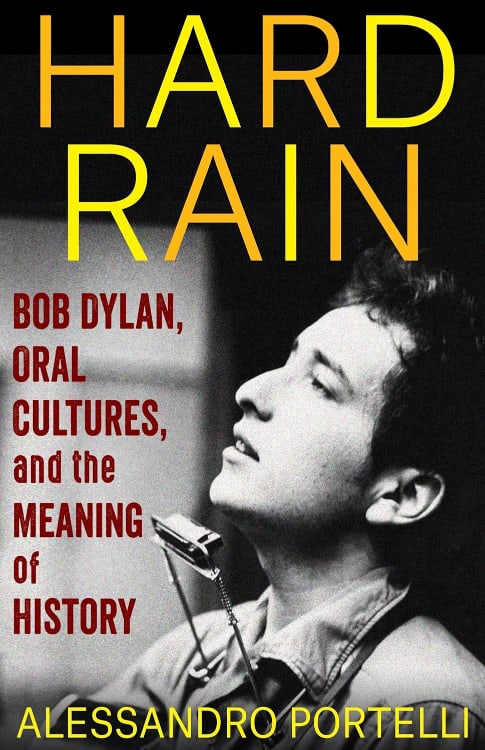
by Alessandro Portelli
New York City: Columbia University Press, 2022, 192 pages, £22 (paperback)
To research and write about Bob Dylan is to enter a labyrinth. There are many paths that one can take, many routes that will lead to successful outcomes, several dead ends and areas that can be avoided without fear of missing out. Books about Dylan and his songs abound, each adding layers to the mix of history, biography and myth that attends this singular artist. This one, by oral historian Alessandro Portelli, is an excellent addition to the collection, adding further layers and unearthing fascinating information about Dylan, his songs, the book’s own author and the study of history. It takes the form of a set of responses to the 1962 song ‘A Hard Rain’s A-Gonna Fall’, mixing these with narratives about the traditional ballads ‘Lord Randal’—upon which Dylan’s song is based—and its Italian counterpart, ‘Il testamento dell’avvelenato’ (‘The poisoned man’s testament’).
Portelli acknowledges that the amount and variety of already existing Dylan criticism is its strength more than it is its weakness. The best books on Dylan know they will never achieve anything definitive, that they are parts of a quilt that will never be completed and that what they must do is to take up a place in the overall image, to be the best and most vivid part of the pattern that they can be. As he notes in his introduction, ‘This explains why there may be excellent books on Bob Dylan that devote only a couple of lines to “A Hard Rain’s A-Gonna Fall” and ignore “When the Ship Comes In,” and why I am writing a Dylan book in which I barely mention “Tangled Up in Blue”’ (pp15-16). What come to the fore instead are the parallel paths, the connections, crossed paths, meandering detours and seemingly endless quests. There are also the personal connections, and Portelli makes it clear that his relationship with ‘Hard Rain’ is ‘an obsession’ (p1) that spans his adult life and that his book about the song is a ‘deeply personal’ one (p124). We learn as much about Portelli and his lifelong exploration of oral history and folklore – and about what it means to study the ‘ways in which the popular classes give voice to their relationship to an process in history’ (p1) – as we do Dylan’s storied songs and career.
Hard Rain is structured around an introduction (on ‘memory, voice and the global Bob Dylan’), four chapters and an appendix that responds to the release, in 2020, of the first two songs from Dylan’s album Rough and Rowdy Ways. The four chapters are: ‘Songs of Innocence and Experience’, covering creativity, influence, narrational devices and – in what Portelli describes as ‘a digression’ – the experiences of migrants travelling from Latin America to the USA and from Africa to Europe; ‘The Text and the Voice’, on the folk process (as theorised by Roman Jakobson, Petr Bogatyrev, Pete Seeger and many more), the relationship between textuality and orality, the spaces of the home and the stage, and poetics; ‘Talking Atomic Blues’, on songs and other texts as responses to actual and potential disasters; and ‘Which Way History?’, a meditation on the ways that folk and other traditional songs (including gospel songs) mediate the relationship between the past, the present and the eternal. Along the way we get to hear fascinating side stories, such as the annual celebration of Dylan’s birthday that takes place in the town of Shillong in India.
As can probably be discerned from this list of topics, these are loosely structured chapters. with each topic functioning to initiate another train of connections between musicians, songs, audiences and various historical actors (‘the folk’). At one point, Portelli refers to Jorge Luis Borges’s classic story ‘The Garden of Forking Paths’ (labyrinths again). For me, this exploratory, twisting form is part of the book’s joy, though I could imagine some readers might find it distracting. At first, I was thrown by the shuttling back and forth between Portelli’s own biographical reflections, his and others’ previously published oral history scholarship and cultural studies of Dylan’s music. As the book progressed, however, I came to see these as the vital fabric from which the narrative is woven. I had a similar response to the large number of endnotes (thirty-five pages of them for 135 pages of main body text); while recognising this additional labour (for both author and reader) could be seen as distracting, I valued it for the evidence it gave of Portelli’s scholarly rigour and the additional journeys it invited me on as a reader (noting a writer’s kinship too, in that I have been ‘guilty’ of this kind of note-to-text ratio in much of my own work). Just as Dylan once famously hinted that each of the lines of ‘Hard Rain’ were potential songs that he didn’t think he’d have time to write, so each of Portelli’s anecdotes and crossed references are both fragments of many other stories and the material for a singular story. Like Dylan’s Whitman-referencing song ‘I Contain Multitudes’ – referenced briefly in Hard Rain’s appendix, alongside the late masterpiece ‘Murder Most Foul’ – Portelli’s book reveals layers upon layers of histories, references and observations.
Hard Rain is a record of Portelli’s experience as a scholar of oral history, literature and song. It acts as a concise record of who and where he has been, what he has seen, and perhaps what he feels he should do next. Where the singer of ‘Hard Rain’ witnesses all manner of fantastical events and scenes, Portelli bears witness to the histories, struggles and dreams of global migrants, youthful rebels, campaigners for social justice and victims of the abuses of power. He also uses countless fragments of Dylan’s song texts just as Dylan has used those of the vernacular music cultures he has drawn from throughout his career. At the close of the ‘digression’ on recent migration experiences between Latin America and the US and between Africa and Europe, Portelli combines lyrics from three Dylan songs: ‘Refugees on the unarmed road of flight, they keep on knocking on heaven’s doors, trying to get to heaven before they close the door’ (p50). In other hands, such mashups might appear trite; I realise it’s possible, taken out of context, this one might appear so here. As a way of sewing up a section of Portelli’s patchwork, however, it works very well.
Early in the book, Portelli writes that ‘“Lord Randal” / “Il testamento dell’avvelenato” is about time, the dangers of uncontrolled change, and the hope of resilience and survival. Taken together, and enriched by their reciprocal resonances, these ballads and Dylan’s song generate a powerful metahistorical reflection about time, change, and the meaning of history’ (p10). That the book manages to stay true to this idea in its relatively brief wordcount is testament not only to Portelli’s skills as a storyteller, but also to the weight that songs can bear and to the value of using song trajectories as a methodology for scholarly work. The potential of what can be learned from using the histories, biographies or trajectories of songs is still relatively (and surprisingly) untapped in my own discipline of popular music studies and I feel there is much that can be learned from approaches such as Portelli’s.