Imperial War Museum, London
26 May 2023 to 7 January 2024, Free Exhibition.
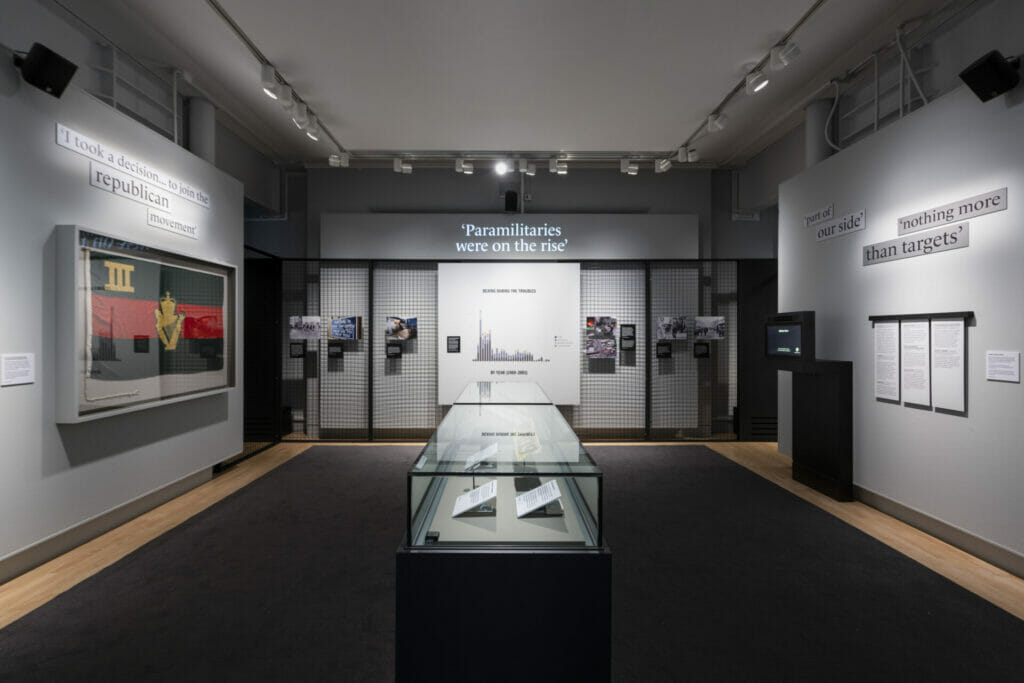
Against the backdrop of ‘The Windsor Framework’ and – at the time of writing – the ongoing suspension of the Northern Irish Assembly, now is as appropriate a time as ever for London’s Imperial War Museum (IMW) to curate an exhibition dedicated to the Northern Irish Troubles. That this conflict – its origins, its machinations, its everyday realities, and its unsettled termination – remains peripheral to the historical consciousness of mainland Britain is something of an understatement. As the exhibition posits in its opening gambit, ‘to many in the UK [the Troubles] seemed, and still does seem, remote and distant’. However, I am reluctant to suggest that this exhibition manages to redress that ignorance. Across four galleries, the IMW works hard to offer an impartial insight into life during the Troubles, but, taken as a whole, the exhibition leaves the visitor with more questions than answers.
It is in the final gallery – ‘Today and the Future’ – that the strongest elements of this exhibition converge. Here, we are exposed to a powerful portrait of Northern Ireland’s uncertain future through a five-minute film combining raw testimony with pointed visual cues. The film’s palette is grey and clouded; in this it already offers a notable contrast to the faux dawn which graces the cover of the Good Friday Agreement displayed in the previous gallery. Rather than an optimistic sunrise (shot off the South African coast), we are given the murky reality of the view from Northern Ireland’s eastern seaboard. The sea functions as a clear object-correlative; the water’s dull hues dovetail with the downbeat testimony that reverberate across each shot. ‘Sectarianism’ is the watchword of this oral document which – despite gathering perspectives from across the ‘divide’ – is unanimous in its belief, or rather fear, that Northern Ireland is now entrenched in a ‘war with words’. Rather than physical violence, we are told how the North’s two communities are now beset with the threat of identity politics being either ‘imposed’ or ‘eradicated’ as sectarianism becomes ‘embedded’, ‘institutionalised’ and ‘ingrained’.
Such depressed predictions draw this film into an introspective search for hope amongst the quotidian colours of Northern Ireland’s soggy streets. As visual artists like Willie Doherty and Paul Graham demonstrated in the 1990s, despite the cessation of physical conflict, Northern Ireland’s banal urbanism is always, already unsettling. In this final video, the UK’s listless street furniture is likewise rendered alien through the sudden and explosive addition of military infrastructure alongside paramilitary murals, both of which refuse to disappear. Watching this film, we are left with the knowledge that Northern Ireland is very much a divided landscape trying – and struggling – to appear ‘ordinary’. As the final voice, and thus the final words in the exhibition, puts it: in Northern Ireland ‘we’re not normal and anyone who thinks we’re normal, needs to look again’.
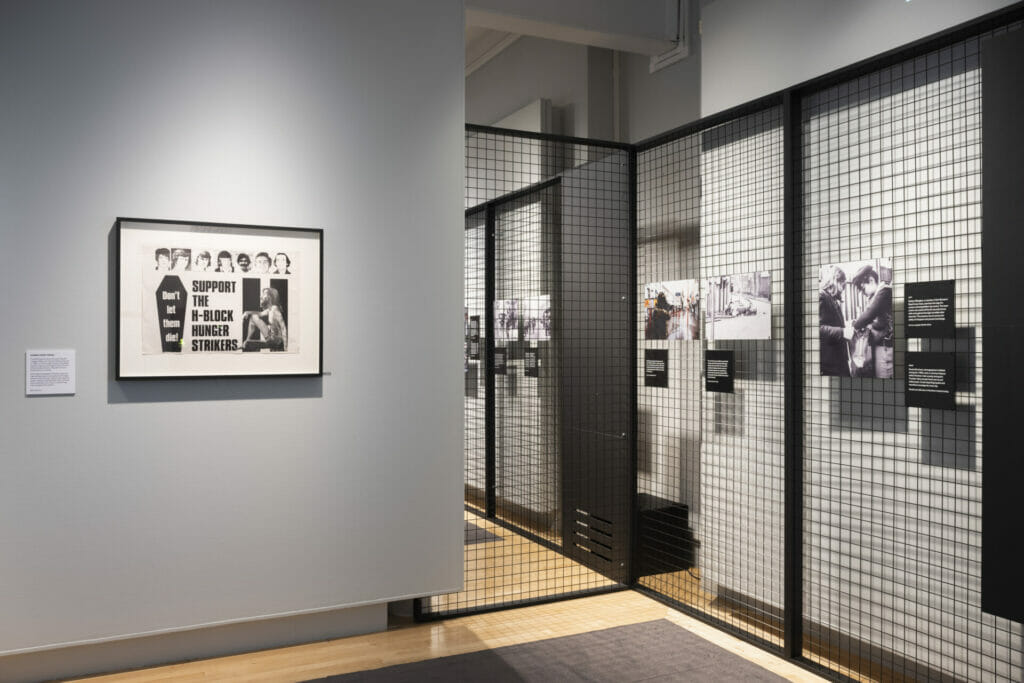
The theme of Northern Ireland’s troubled normality is powerfully wrought in the penultimate gallery of an exhibition that gets stronger as it proceeds. In ‘Hell in a wee place’, visitors are treated to early shots of what Eyal Weizman and Stephen Graham would call ‘splintering urbanism’. This gallery is dominated by a square colour photograph of shoppers pacing past the large security cages that came to dominate Belfast’s city centre from 1972. With such a photograph in view, the caged aesthetic that forms the walls to the entire exhibition takes on new resonances: no longer just the shorthand for a war-torn environment, but the reality of a fortified infrastructure normalised by its constant presence. It is in this gallery, perhaps, that a British audience comes to appreciate the surreal experience of ‘Living with the Troubles’. On one wall, a poster of Tufty the Squirrel gives public information not about road safety, but a ‘darker warning’ about the dangers of picking up a suspect device. On another wall, photographs of pedestrianised high streets and high-density housing, familiar to many a mainland suburb, are made startlingly unfamiliar by the camouflaged presence of soldiers looking straight down the sights of their rifles.
Nonetheless, touring through this gallery, one of the exhibition’s glaring omissions also becomes apparent: given we’re in the IMW, where, exactly, is the British Army? We get a glimpse of their presence in these photographs but otherwise the role and function of the British Army is absent from the exhibits – save for one cabinet featuring a set of rubber bullets in all their ominous size and scale. Perhaps, the relative absence of the British Army is symptomatic of the larger sensitivities with which the IMW team has curated the exhibition. Before you even enter through the gallery’s Perspex doors, we are alerted to the ‘different perspectives’ that will form the grammar of what follows. ‘I wanted to explore the fact that so much of what took place during the Troubles is contested’, states the lead curator Craig Murray. ‘I have left much of the storytelling to the people who experienced the conflict to address these narratives in their own way’. Given the unanimous vision of an unsettled future with which the exhibition concludes, the presence of such varied perspectives is a welcome feature in the preceding galleries. Consequently, in each gallery, a compact black box reminds us to listen with impartial ears: ‘It is for you to decide whether you agree or disagree with the voices you will hear’. The recurrent emphasis on this neutrality is a little unsettling, however. As these prompts recur, I am reminded of the oft-cited paradox that ‘there is nothing more political than that which claims to be devoid of politics’.
Despite the IMW’s numerous attempts to handle its exhibits with white gloves, the exhibition does still leave traces of its political fingerprints. At times these residues can jar with the latest historical analysis of the Troubles. The Ulster Defence Regiment, for example, features prominently in the middle galleries but they are presented to us as an entity only ‘accused’, rather than documented, to have been ‘colluding with loyalist paramilitaries’. Wranglings over historic Troubles-related offences notwithstanding, the truths around military activities emerging from the archive need to be acknowledged.1 At other points, however, the exhibition’s political leanings adopt a more progressive tone. In the penultimate gallery, Jeff Dudgeon’s oral history whispers a powerful critique of those historic forces that have shaped Northern Irish society. Speaking on behalf of Belfast’s gay community, Dudgeon’s testimony foregrounds a queer politics that transcends the sectarianism of the Troubles, while simultaneously condemning Northern Ireland’s repressive position on sexuality. ‘We were essentially living a separate life aside from the Troubles’, recalls Dudgeon. ‘Partly because we were a mixed community, people kept their mouths shut; they didn’t argue the case’. It is through such oral history that we are given a glimpse of an alternative way of living in Northern Ireland. Indeed, if nothing else, the surfacing of such ecumenical perspectives serves as an important reminder: perhaps it is in those most marginalised by society that we might find solutions to the impasses that otherwise look set to dominate Northern Ireland’s future.
- See Micheál Smith, UDR Declassified, Newbridge: Merrion Press, 2022. ↩︎
All photos by Kathleen Arundel