by Robert Fell
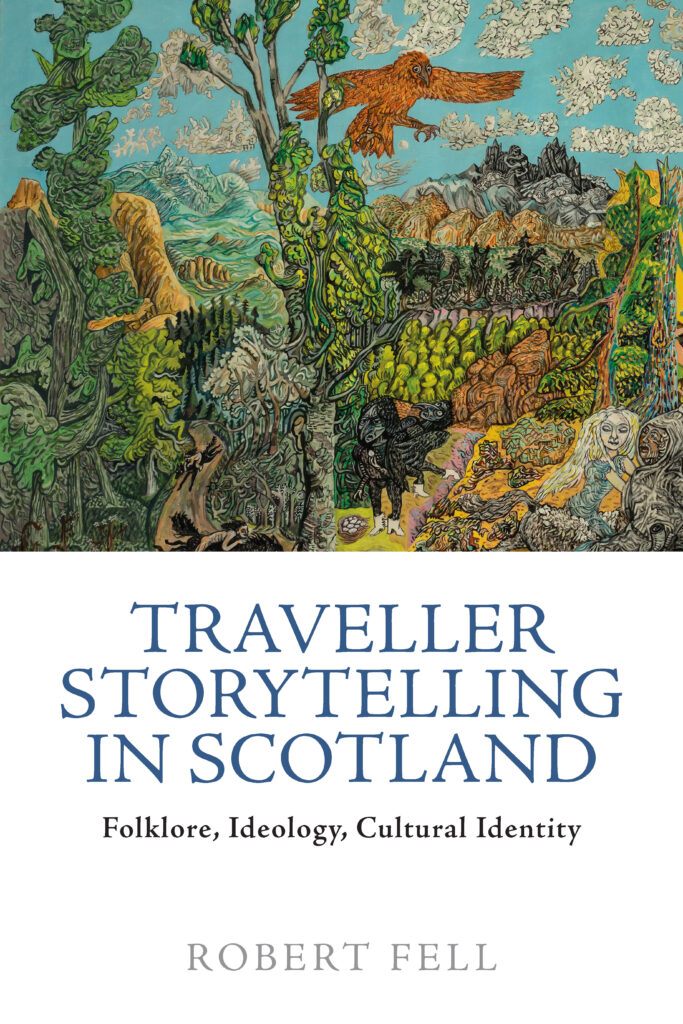
Edinburgh, Edinburgh University Press, 2024, 227pp, £90, hardback.
The ‘discovery’ in the early 1950s of the rich storytelling tradition of Scottish travellers, when this had all but disappeared amongst Scots-speaking lowlanders, has tended to play into scholarly separation between oral history as a branch of social history (people talking about what they did) and oral tradition (songs, traditional narratives and linked verbal arts). Attempts to bridge this have been going on for decades: fifty years ago Eric Cregeen argued in this journal for using oral sources as social history in a way that also took account of the traditional, folkloric nature of the material collected from speakers who were still bearers of a rapidly declining traditional oral culture.1Eric Cregeen, ‘Oral Sources for the Social History of the Scottish Highlands and Islands’, Oral History, vol.2 (1974), pp 23-36. As Robert Fell’s study of traveller storytelling shows, stories are not only something they have but something they do.
Travellers typically used a traditional repertoire to articulate and share common values and experiences as an often shunned or persecuted minority group: ‘For many Travellers, oral narratives are a central part of their early education and upbringing …The concept of education being delivered through storytelling as part of the intellectual developments associated with childhood is affirmed by Stanley Robertson. Robertson explains that growing up, “nearly a’ the auld Traveller women telt ye stories” [TAD 50189]’ (p60).
Tangible value was placed on this type of storytelling: ‘John Stewart tells us that as children, Travellers would use stories as a form of currency, to be used in exchange for things that other children had [TAD 65775]. Duncan Williamson shares a similar experience where he once “walked intae Coupar Angus for an ounce o’ bacco” [TAD 30610] to exchange it for a story from Johnnie MacDonald, who was “a great storyteller”’ (p62).
Fell draws on a tremendous body of traveller oral history and traditions recorded in particular over the second half of the twentieth century by researchers from the School of Scottish Studies at Edinburgh University. This includes celebrated storytellers like Duncan Williamson (1928-2007), Stanley Robertson (1940-2009) and Betsy Whyte (1919-1988), whose tales and reminiscences were widely published. As well as this, Fell uses interviews with more recent storytellers, writers, and activists like Davie Donaldson, Shamus McPhee and Jess Smith. Taking this corpus of stories and lore as well as the recorded reflections on this repertoire, Fell proposes the concept of a ‘Nackian’ aesthetic that embodies shared experience. This is based on the term Nacken/Nawken used by some travellers to identify themselves. He outlines the historic position of travellers in Scotland and sketches current ethnographic approaches to narratology before giving detailed and thought-provoking analysis of re-tellings of tales and associated place-lore and ideas of the supernatural. A chapter is given to Burker stories. This is a widespread genre connected with the activities of William Burke, who murdered people to sell their corpses to anatomy schools. Numerous examples of such stories recorded from travellers for the School of Scottish Studies are digitised on the Tobar an Dualchais website. For travellers, Fell argues, these stories had special resonance and were used not simply to address anxiety about being outsiders, but to explore a wider gamut of social experience.
The Burker stories show clearly how tropes in storytelling also framed and shaped less overtly formal narration or oral history. His first Burker example comes from John Stewart (b. 1870) who recalls an experience from his childhood when his tinsmith father sent him, along with his sister and niece, on an errand. Unable to get back home, they seek lodgings at a farm. They end up trapped in a barn and have a narrow escape from what they later are told by a shopkeeper were Burkers. As Betsy Whyte exclaimed, ‘it was true, they did Burke the Travellers, they did [. . .] that went on all over. And although youse folk [settled communities] mibbe disnae believe it, it goes on as much now as it did in these days [TAD 77229]’ (p127). As Fell concludes, ‘By blending reality and fiction, the Burkean narratives’ function is to structure the latent representational meanings of the stories upon real situations’ (p177).
To draw out what these stories might mean, Fell draws from literary criticism on the premise that this type of storytelling deserves to be treated with as much attention to subtlety and nuance as any literature. The point is proven but literature and literary criticism are close relatives and by looking through this lens the fluid, contingent qualities of orality are not exactly ignored but de-emphasised. The idea of a ‘Nackian’ aesthetic has a fixing effect since like any such term it can tend to the prescriptive as much as the descriptive. It is presented in terms of a positive ‘cultural identity’ which offers a critical commentary on the ‘non-Nackian’ values which have often been hostile and oppressive. But would any common aesthetic be that coherent or consistent? What of the cumulative impact of compulsory education and mass media, and a changing economic landscape and opportunities? Also, might the very appearance of ‘folklore’ performers, and of a primary and secondary print literature of traveller tales have fed back to reshape tradition in a particular ‘folkloric’ direction?
In my own interviews with travelling showpeople, also often stigmatised by the settled community, while they had no ‘traditional’ storytelling, there was widespread sharing of value-laden anecdotes about people, events and places which bolstered an affirmative sense of group identity. But with this came a ranking of members of the group, a sense of constriction and conservatism. This might also run through ‘Nacken’ storytelling but is it ‘Nackian’? In his conclusion Fell says: ‘Both personal and cultural autonomy are at the heart of the Nackian folk idiom; cultural identity, folklore and ideology are ultimately linked in the Travellers’ storytelling traditions through the affirmation of the communities’ cultural legitimacy’ (p203). There is no doubt of the value of being able to define yourself, not being subject to others’ definitions, but what of those within a community that do not fit putative definitions.
TAD numbers refer to the track ID on the Tobar an Dualchais website: https://www.tobarandualchais.co.uk/
Footnotes
- 1Eric Cregeen, ‘Oral Sources for the Social History of the Scottish Highlands and Islands’, Oral History, vol.2 (1974), pp 23-36. ↩︎