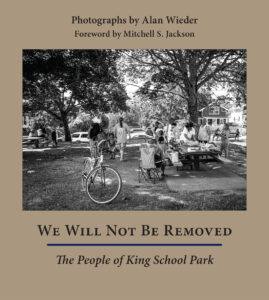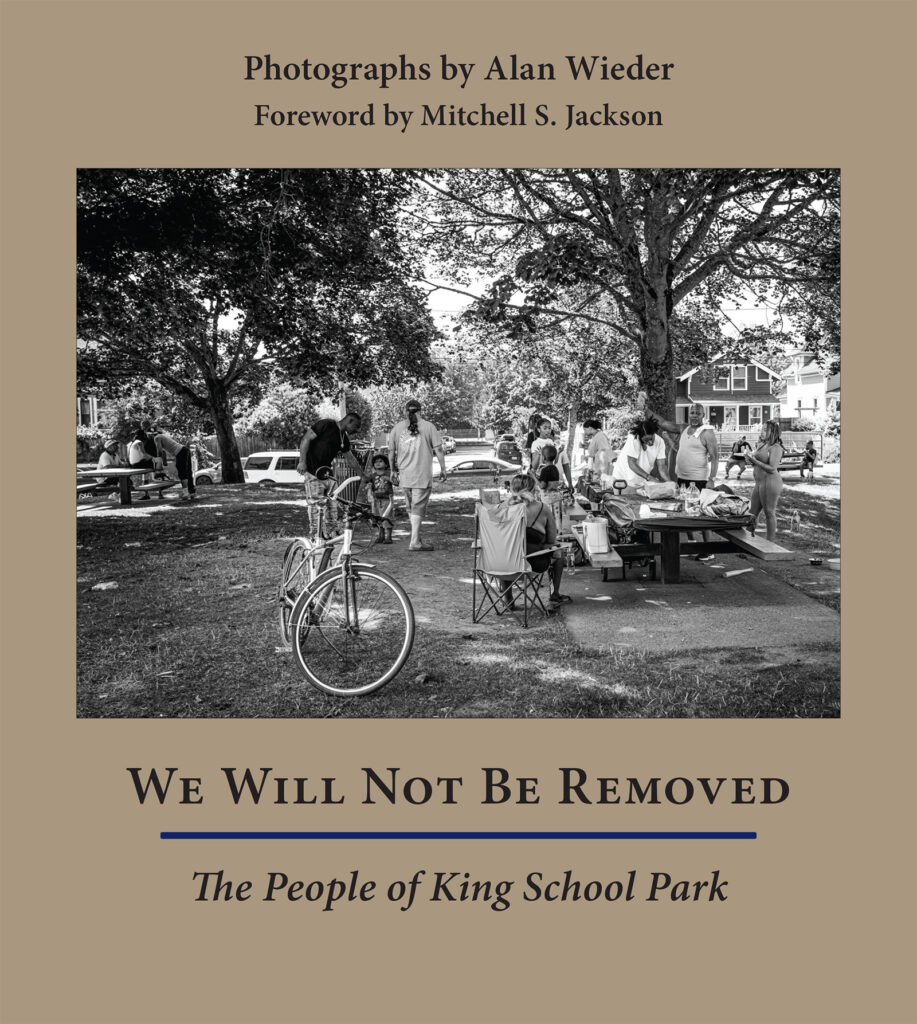
by Alan Wieder
Oregon: Oregon Cultural Heritage Commission, 2025, 145pp (£23, hardback), ISBN 9781962645447
The particular cruelty of urban displacement has something to do with the moral framing that accompanies it. As spiralling housing costs, evictions, repossessions, and other hallmarks of state and municipal-led gentrification have swept away long-standing communities in cities across the globe, interlocking discourses of decline and renewal are invariably called upon to justify and facilitate these processes. Here, race and place-based stereotypes work alongside superficial narratives of ‘revitalisation’, ‘opportunity’, and ‘social mixing’ to erase communal identity and social ties, to conceal years of disinvestment, and, in North America especially, to obscure historical racist housing practices.
Take, for example, the Albina District in north and northeast Portland, Oregon. Once home to the vast majority of the city’s African American residents, the implementation of several ‘renewal’ projects in the 1960s and ’70s and the advent of gentrification in the 1990s spawned an exodus. Between 1990 and 2020 – a period in which Albina’s overall population grew substantially – black residency in the district more than halved.[i] It was a process underpinned by dominant inner-city imaginaries of dereliction and dysfunction, and, correspondingly, what geographer Neil Smith described as a ‘pioneering’ impulse for profit.[ii] As author and former Albina resident Mitchell S. Jackson explains in the foreword of Alan Wieder’s We Will Not be Removed: The People of King Park School, the effective abandonment and cultural scripting of the area was always predicated on structural exploitation: ‘Soon enough White people roamed the hood selling not products but offering to buy houses’ (p.xiii).
Wieder’s new book presents a powerful alternative to the hegemonic discourses of urban change. Comprising a series of black and white photographs and oral testimony captured between 2020 and 2024, it tells the story of some of the residents and returning former residents of the neighbourhood surrounding Albina’s King Elementary School. As above, this is a community that has been buffeted by the deracinating forces of gentrification. And yet, as Wieder sets out in the introduction, it remains tenuously bound together by the rituals and routines of daily public assembly in the school’s adjoining park. ‘In spite of being displaced, this community survives,’ he writes. ‘Birthdays are celebrated, tragedy is commemorated, and, most important, people who grew up in the neighbourhood, as well as their offspring, connect in the park each day’ (p.xv).
The photographs offer an achingly beautiful portrait of everyday life at King School Park. We see, for example, a group of friends toasting over a picnic table; two men preparing food on a barbeque; a girl sitting in her mother’s lap, their arms and hands entangled, both smiling at the camera. At times, the accompanying text adds to the sense of prosaic beauty: a woman shown smiling in roller skates and kneepads, seated next to her granddaughter, describes how she acquired her nickname: ‘The Black Panthers formed a breakfast programme for the kids. And that gave me inspiration to feed people. Now the younger people call me Mama Rose’ (p10). Elsewhere, a man pictured holding a puppy (puppies and dogs are depicted frequently in the series) states that ‘Raising dogs was an accident. Princess had puppies…now there’s seven litters. Brothers and sisters and generations’ (p60). By illuminating everyday practices of kinship and communality in the park in this way, the book largely moves beyond the shallow pool of representations through which black lives are typically made visible, and upon which processes like gentrification are staked. Rather, it captures a demystifying impression of the neighbourhood from the inside, while saying something important about the ineffable ties of childhood experience, social memory, and home.
At the same time, the book is testament to and a political statement about the staying power of an oppressed community. As described variously across the book, the King School neighbourhood was both product of and an invaluable haven against a history of racist exclusion in Portland, and thus the park has become something of a bastion or defensive holdout amid the community’s battle against displacement. One of the men photographed describes the near daily act of returning to the park, despite being ‘pushed away’ from the neighbourhood, as a matter of ‘holding on’ (p2). Another, Karl, states that ‘[T]hey took everything. They took so many things. We don’t want them to try and take this. So, we claim this’ (p6). Certainly, the testimony elicited by Wieder – an oral historian of US school desegregation and the anti-apartheid struggle in South Africa, among other subjects – articulates a claim to space that is grounded in history and familiarity, in family and care.
There is an important intergenerational dimension at play here. Both the pictures and words imagine King School Park as a close-knit community where residents of all ages are protectors of place and one another. As gentrification works as a form of enclosure, children are free and safe to roam. As it avoids any recognition of the area’s history as a matter of course, long-term residents and former residents act as custodians of the past in order to have a say – and secure a place – in the neighbourhood’s future. ‘Well, the main thing is that the park is here for us to reunite and show our kids where we come from,’ says one interviewee (p94).
Only rarely does Wieder’s thoughtful account miss the mark. One photograph, for instance, depicts two men sitting in a car, the closest to the camera posing with a stack of fanned banknotes. The picture feels disharmonious with the rest of the series and against the corresponding text (about exploitative property practices). Drawing on the familiar tropes of blackness, it also adds little to the book’s prominent themes of connection, conviviality, safeguarding, and struggle. This, however, is not to cast any doubt on the moral and political vision of the project, and nor is it to diminish the power and nuance of this important visual and testimonial narrative.
[i] Nigel Jaquiss, ‘The Black Population of Inner North and Northeast Portland Continues to Shrink’, Willamette Week (25 August 2021), https://www.wweek.com/news/city/2021/08/25/the-black-population-of-inner-north-and-northeast-portland-continues-to-shrink/
[ii] Neil Smith, The New Urban Frontier: Gentrification and the revanchist city (London: Routledge, 1996), 19.