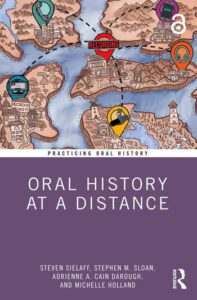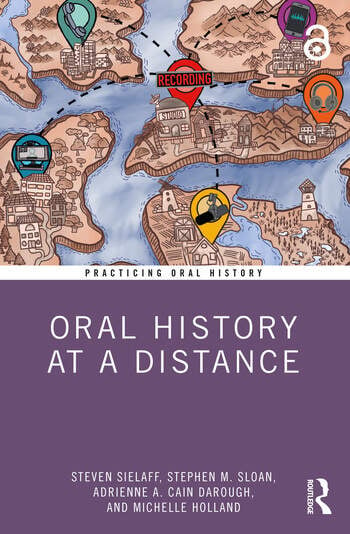
By Steven Sielaff, Stephen M. Sloan, Adrienne A. Cain Darough, Michelle Holland (eds)
New York: Routledge, 2024, 228pp., paperback
‘Oral history in the midst or immediate aftermath of crisis’, writes Stephen M. Sloan in his Introduction to Oral History at a Distance, ‘is a phenomenon that has become an increasingly common application of the methodology’ in recent years (p3). The Covid-19 pandemic was certainly a crisis but also, writes Nancy MacKay in the volume’s Foreword, ‘an opportunity to capture history in the making’ (pxv). This opportunity, notably, accelerated the use of remote oral history interviews. Although ‘taped telephone-based exchanges’ and online videoconferencing have been used since the 1970s and early 2000s respectively, the full potential of remote interviews and projects has been underexplored (pp4, 6–7). To quote MacKay again, ‘we did our very best during these early pandemic days. Only one thing was missing: a road map for best practices to guide us through this new reality’ (pxv). This volume, put together by four colleagues from the Baylor University Institute for Oral History (BUIOH, founded in 1970) in the aftermath of Covid-19, is an important step in charting that map.
As Sarah Dziedzic, an oral historian who is immunodeficient and was successfully conducting remote interviews before Covid-19, lamented in a 2020 piece, ‘it should not have taken a global pandemic for oral historians to evaluate the safety and accessibility of our in-person interviewing’.1 For all oral history’s claims to be a democratised and inclusive methodology in terms of who can use it and whose stories it facilitates, this was unfortunately the reality.2 Remote interviewing has received little coverage in oral history readers or best practice guidelines.3 Sloan notes in his Introduction that even an ‘Oral History in the Digital Age’ project contained ‘no pieces [on] fully remote projects, and […] scant mentions of distance recording’ (p6). The wariness towards remote interviewing was underlined at the beginning of the Covid-19 pandemic, with organisations like the Oral History Society (UK) and the Oral History Association (USA) more concerned with its drawbacks (ethical, legal, technical, etc.) than its possibilities (see pp9, 185–187). BUIOH, by contrast, pulled together by the end of March 2020 a webinar about conducting projects remotely. This ‘can do’ attitude was vindicated by the attendance of over five hundred people, of whom 87 percent had conducted remote interviews by 2022, and was the impetus behind this volume’s compilation (pxix).
The book is divided into four sections. The first, ‘Chapters’, covers a range of topics about how to plan and run an oral history project, with a focus on the necessary adaptations and considerations for remote interviewing and remote working. It is rather ‘textbook’ in terms of style, in that it is very clear and does not assume a great deal of oral history experience or knowledge on the part of the reader. This means the book will be accessible for practitioners (academic, community, or otherwise) who are new to oral history. More experienced practitioners may find the early chapters cover ground they already know but will find later chapters (Chapter 5 on ‘Interviewing at a distance’, 6 on ‘Remote recording technology’, and 7 on ‘Preserving remote recordings’) of interest. The volume’s authors have consciously avoided ‘the false dichotomy’ of whether in-person or remote interviews are preferable and have considered the impact of remote working on projects generally rather than just the interview (p83). In so doing, they have engaged in considered, experience-driven reflections based on their own practice and on other projects they have encountered in a variety of academic and community contexts. The fourth part, ‘Appendix’, complements these textbook-style chapters with examples of the forms and paperwork BUIOH uses to manage their projects, whilst the second, ‘Case Studies’, introduces nine projects which have integrated remote interviewing in various ways; the third details the results of BUIOH’s 2022 survey (a follow-up to their 2020 webinar) about remote interviewing.
Like any reader or textbook, Oral History at a Distance is – short of regularly updated editions being produced – rooted in the time of its production. This is already the case, for instance, with the context of Covid-19 where the important considerations of one another’s safety and the restrictions of various lockdown periods meant that a key question for many projects was ‘can it wait?’, a question which in a post-Covid-19 world may no longer be the dealbreaker between an in-person, remote, or mixed project (p 25). The same is true of discussions of particular software or equipment, as noted by Steven Sielaff in the afterword: ‘Any publication that deals with technology can often be outdated as soon as it hits the market’ (p155). However, the development of a companion website, updated by BUIOH twice annually, should go some way to ensuring that this volume endures. It is also worth noting that whilst BUIOH’s approach to oral history is institutional and team-based, this may not be possible for all oral history practitioners, especially those working on community projects with limited funding or in increasingly constrained Arts faculties in universities in the United Kingdom. This should not, though, discourage potential practitioners and nor does it undermine the utility of the advice on offer within this volume; much like the example forms in Section four, it is for readers to adapt the guidance to their own needs and projects.
Oral history is still finding its feet with remote interviewing so any contribution towards refining the methodology around it is welcomed – particularly considering, as Section two shows, the variety of wonderful projects embracing remote interviewing today. This book may not be the ‘road map’ – indeed, having only one may not be possible or even desirable – but it offers many useful signposts and suggestions. Not every oral historian can replicate the institutionalised, team-based approach advocated by BUIOH, and more experienced practitioners may find elements of the book too basic for their needs. However, all readers – whether experienced or novices, academics or community practitioners – will find useful elements for constructing and managing their projects, particularly as regards the important and expanding realm of remote interviewing.
- Sarah Dziedzic, ‘Immunodeficiency and oral history’, Medium, 07.05.2020, <https://medium.com/@sarahdziedzic/immunodeficiency-and-oral-history-85695925dd43>, accessed: 24.06.25. ↩︎
- See, for example, Lynn Abrams, Oral History Theory (2nd ed.), (Abingdon: Routledge, 2016). ↩︎
- Pierre Botcherby, ‘Best practice versus reality: Arts at Warwick, coronavirus, and remote interviewing in oral history’, Exchanges: The Interdisciplinary Journal, vol 8, no 4, 2021, 113-125. ↩︎